Pet Allergy Investigation Checklist

If it seems like your veterinarian wants to run a million tests, this checklist can help you keep track of the tests.

Chocolate Standard Poodle with smooth, bald patches of skin around his eyes and on the bridge of his nose
Where’d my face fur go?

Diagnosing an Allergic Pet Takes Medicine and Sleuthing

Work with your veterinarian to figure out your pet’s allergies.  If more than one pet in your household is allergic, do not become discouraged, about 50% of American pets are allergic.  It is probably not a poisonous horrible thing you did to your pets, it’s probably just that they are related by family, breed, or they are all in the affected 50%!

If it seems like your veterinarian wants to run a million tests, this checklist can help you keep track of the tests, and maybe reassure you that all the investigation is needed!

“I check the general health of a patient first, because back health or a disease and make allergies worse,” says Doc Truli.  “Then we ‘control the controllable’ with a food elimination diet, and give nutritional supplements to see if the allergy resolves.  Then we go into excluding common skin diseases and then finally, allergy testing and treatment.” Continue reading “Pet Allergy Investigation Checklist”

Allergic Pet?

Up to half –half — of American cats and dogs, and probably just as many worldwide in industrialized countries, suffer from atopy. Atopy is a fancy word for allergies to inhaled allergens.
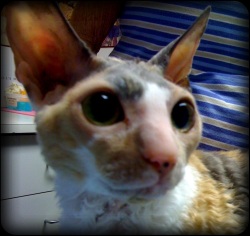
rex cat

Allergies in Dogs and Cats

Common Symptoms

  • Runny Eyes and Nose
  • Rubbing face and ears
  • Licking paws
  • Licking belly fur
  • Scratching all over
  • Red, red skin
  • Recurrent bouts of “hot spots”
  • Frequent, inexplicable “sensitive stomach”

Atopy

Up to half  —half — of American cats and dogs, and probably just as many worldwide in industrialized countries, suffer from atopy.  Atopy is a fancy word for allergies to inhaled allergens.  The standard allergy selection panels check for mites, molds, pollens, grasses, cat dander, human dander, and insects like fleas, usually about 60-80 allergens in a standard geographically regional “allergy test.”

Food Allergy or Sensitivity

Then 10% (by recent estimates) of dogs and cats suffer from food allergies.  There are no statistically accurate laboratory or skin tests for food allergies in pets.  An allergy elimination diet trial must be performed.  VirtuaVet has a comprehensive article explaining how to perform your own allergy elimination diet trial at home.

Allergy Treatment in Dogs and Cats

Medicine

70% of dogs respond favorably to allergy treatment with custom-made allergy desensitization shots and many respond to cyclosporin modified capsules of immunomodulatory medication, which often continues once a month for years or for life to keep allergies under control.

Remove/Avoid the Allergen

Occasionally, the allergen is removable from the pet’s life.

“I had a patient who came up with a 5 out of 6 score on a blood allergy test to Red Cedar.  I’d never even seen higher than a 4 of 6 before this little Westie,” said Doc Truli, “Luckily, his dad switched to pine needles, instead of Cedar mulch in the yard, and the symptoms cleared up!”

Nutrition

Many pets respond favorably to immune system strengthening.  Whether a deficiency is corrected, or the nutrition boosts the immune system is a debatable subject.

Omega-3 Fatty Acid Supplementation of a Quality Fish Oil or (for dogs) Flax Seed Oil with the subcomponent called “EPA” at the proper published dose to boost the immune system and decrease itchiness.  DO NOT supplement your dog without consulting your veterinarian (that’s why I did not publish the dose here; VirtuaVet is not responsible for what you put in your pet’s mouth!)  Some dogs, like Miniature Schnauzers, are prone to potentially deadly pancreatitis and could die from a change in their fat intake!

Cats lack an enzyme needed to convert flax omega’s into active, useful omega’s, so feed your cat a fish oil source of Omega 3’s like menhaden fish, salmon, cod liver oil, anchovy, or krill.

If you home cook for your dog, or already have a skin/coat health/allergy diet, it may already have enhanced Omega 3 Fatty Acids.  These fats accumulate in the fat storage areas of the body and therefore, can become overdosed and make your pet sick.  Your veterinarian can advise you.

Ask your veterinarian about adding Vitamin E to your pet’s diet for immune system health, skin health, and decreasing itchiness.  Some scientific research says Vitamin E does not help in people, but the research is performed on incomplete, laboratory-made Vitamins.  Research done with fresh, natural Vitamin E proves it’s amazingly helpful qualities.  Plus it helps the body absorb Omega 3’s better!

There is no published dose for Vitamin E in dogs and cats.   Ask your veterinarian to decide on a dose for your pet(s).

Both Omega 3’s and Vitamin E are Fat Soluble vitamins.  This means they are stored in fat in the body and you can overdose and cause serious disease with too much.  More does not equal better with fat soluble nutrients!

Topical Therapy

Shampoos, lotions, oils, grooming, ionizing bath treatments, oatmeal baths, proper timing of baths.  (Some dogs need weekly, some get worse with weekly, ask your vet!)  These all help.  Some contain prescription pharmaceuticals like hydrocortisone, diphenhydramine and pramoxine.  They help.

VirtuaVet Digs Deeper for the Pet Who Still Suffers Allergies

Sometimes you’ve “done everything.”  Next time on VirtuaVet, read about common mistakes people make when trying to figure out their pet’s allergies.  Then. after that, next week, VirtuaVet explores potentially toxic cosmetics and cleaning agents you may still be using.  Half of them are “green!”

Reference

VirtuaVet’s 4-Year-Old Staffordshire Terrier Finally Allergy Free, detailed Article on How to Perform Your Own Allergy Elimination Diet Trial at Home.
Two Dogs Saved by Ethics, not Medicine!

Does a pet owner have the right to order euthanasia of a young, healthy pet?

yellow lab mix
Saved!

Veterinarians Often See Accusations of Abuse or Human Mental Illness

A few days ago, Doc Truli came across a Phoenix Examiner article about Antifreeze Poisoning in three pet dogs.  One of the anonymous comments caught her eye:

Anonymous wrote:

The owner Jasmine is a nutcase.  She makes pet profiles at dogster.com, says they died, gets sympathy, then removes the pages.  A few days after these dogs died she got a new dog named Aldo.  Guess what?  he got poisoned too behind a fenced in patio! and his page is now gone.  She either did this herself or knows who did it because she never does anything about it and states that her family hates her new dog Aldo so anyone could have poisoned them!  She needs to be stopped and never get a dog again because she endangers the life of every dog she comes near.  How many more dogs will suffer die at this mad woman’s hands?

Of course, we do not know if there is a “Jasmine” or three dead dogs, or an anonymous poster, or a new dog named “Aldo.”  Perhaps the exchange is a fiction created for scintillation and attention.  But every veterinarian who has practiced medicine more than a few months has seen or heard amazing things that would not be believed if it wasn’t real. Continue reading “Two Dogs Saved by Ethics, not Medicine!”

Antifreeze Poisoning or…

Doc Truli’s Short List of Causes of Sudden Kidney Failure: Get to an Animal Hospital Right Away!!!!!

Seal Point Himalayan Cat
VirtuaCat

Doc Truli’s Short List of Causes of Sudden Kidney Failure: Get to an Animal Hospital Right Away!!!!!

  • Antifreeze – ethylene glycol poisoning
  • Lyme Disease Vaccine
  • Lyme Disease rickettsial infection
  • Leptospirosis bacterial infection
  • ***Cats**** (Remember this at Easter and Christmas) – Eating Lilly Plants, any part of the plant, even one bite causes sudden, kidney failure in cats.  No cure; they die!
  • ***Dogs*** Raisins, grapes and currants.  Possible only a few of the fruits could cause it!

“VirtuaCat, being a lazy Himalayan pussums, barely notices floral arrangements on the dining room table.  Still, we have a rule in our house: no lilies in or near the property, ever!” says Doc Truli.

Symptoms of Sudden Renal Failure

  • excessive thirst and urination
  • incoordination, called ataxia (legs not organized right)
  • weakness
  • nausea and vomiting
  • tremors, usually whole body
  • rapid breathing and heart rate
  • diarrhea
  • convulsions and seizures
  • paralysis

Read More on VirtuaVet:

Antifreeze Poisoning

Even a Few Licks of Antifreeze Matter!

Charlie’s Dad turned to face Doc Truli, “Just licking antifreeze wouldn’t make him so sick, would it? If he did lick it, it was just a tiny amount.”

Shaggy white dog, about 20 pounds, with brown ears and long nose
Charlie

How Can a Perfectly Watched Pet Get Sick in a Day?

Charlie looked like a rag on the animal hospital ceramic tile floor.  He did not look up, nor did he greet Doc Truli with a tail wag, not even the tippy tip.  Charlie could not summon the energy to lift his own head.

“We just found him like that in the front hallway,” said Charlie’s dad.  “I swear he was perfect last night.  We always go out with him on walks, he’s never alone.  Same bag of dog food, no new treats.  We never give him treats made in China.  He’s on a holistic, all-natural diet.  Charlie’s never out of our sight.  I don’t understand how this could be happening! Continue reading “Even a Few Licks of Antifreeze Matter!”

Dog Halloween Costume or….?

The ultimate dog Halloween “look.”

fluorescein dye eye test equals green glow around eyes in a reluctant chihuahuaCheck this out!

The ultimate dog Halloween “look.”

No, really.  This Chihuahua woke up with red irritation in the whites of his eyes.  He was blinking and squinting and tearing and it just wasn’t a good situation.

First, little Romeo had his eye pressures measured.  Normal.   So, no glaucoma!  That’s good news!

Nothing looked wrong with the corneas on the physical examination, but before prescribing any medication which could potentially make a corneal scratch or ulcer worse, a fluorescein dye test was needed. (People get this, too!)

The dye looks orange when you open it up.  Then, mixed with sterile saline or tears, it turns a green-yellow color.  Turn out the lights, turn on a black-light, and viola!  Halloween doggie!

“A normal corneal surface on the eye repels liquids and dust and washes away irritating little what-nots that can damage your eyes.  If the dye sticks anywhere on the surface of the eye, then you’ve identified a defect in the surface,” says Doc Truli.

Ever get sand or dust in your eye?  Hurts, right? Corneal ulcers and scratches are super painful.  People even call  in sick to work from a corneal scratch.  Ask your veterinarian if any of the medication they’ve prescribed helps with the pain.

Romeo’s flourescein dye washed off the eyeball readily.  No ulcers or scratches.  A plain old cause of conjunctivitis (usually non-contagious in dogs BTW).  Some eye drops and a few days out of the sun and Romeo was as good as ever!

Barium Study in a Dog

Of course, x-ray interpretation is part science and part art of medicine. Seeing the problem with your own eyes during endoscopy or surgery is the only way to be sure of the interpretation on the barium study…

mop eaterWeight Loss, Vomiting, and Intermittent Soft Stool in a German Shepherd Dog
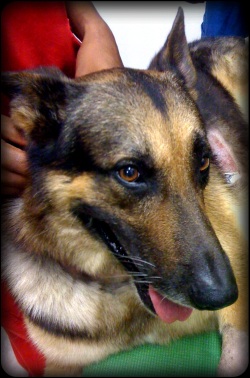
Frisko panted nervously and looked up at the Doc from underneath steady eyebrows.  He doubted he needed to see the doctor.  After all, dogs vomit occasionally, right?  The 5-year-old male black and tan German Shepherd Dog thought he had everything under control.  Except he lost 6 pounds in one month! Oops!  Rapid weight loss in a dog for no good reason warrants a trip to the animal hospital.

Continue reading “Barium Study in a Dog”

Murphy's Top Ten Laws of Veterinary Medicine

#3 There is a secret agreement among all pets. They know when a long holiday weekend is coming up and get sick just then.

cat holding ear downMedical Secrets Medical School Deems Unscientific
Doc Truli has determined there are secret Laws of the Universe governing health and medicine.  Here are a few for your edification.

  1. If you have the lab results on a Friday night, you will not need to go to the pet E.R.  If you do not have them in hand, your pet will need to go to the E.R.
  2. Never end a prescription on a Saturday night.  The pet will relapse when all the vet offices are closed.  If the pet has the medicine, everything will be perfect.
  3. There is a secret agreement among all pets.  They know when a long holiday weekend is coming up and get sick just then.
  4. If your pet vomits and you decide to buy all the medication the vet recommends, your pet will get better like nothing happened and make you feel like you wasted your money.  If you skip the meds, figuring the white rice will work, your pet will vomit all night until intravenous fluids and a $1,000 vet bill become mandatory to save your pet’s life.
  5. If you say “no” to annual, routine bloodwork to check for hidden disease in your pet, your pet will get sick the next week, making you feel guiltier than anything before in your life.
  6. If you say “yes” to the annual screening lab work (in pets 7 and older, 30% chance of an abnormality on routine lab tests in a healthy-looking animal), your pet will also get rip-roaring sick in the next week.  But at least you will know it’s a new problem and you won’t feel guilty.  So, does preventative medicine prevent disease, or does preventative medicine just prevent guilt?
  7. All coughs and limps disappear at the animal hospital.
  8. Your unspayed female dog will come down with a life-threatening pyometra infection 1 week before you finally scheduled the spay procedure to try to avoid pyometra!
  9. Female dogs and cats do not go through menopause.  Just when you think babies are impossible, bam! A litter!
  10. A corollary to #9, no, the puppies and kittens do not “just know” that they shouldn’t mate with their own brother or sister.  And they will get to that task as young as 6 months of age!

Hope these Murphy’s Laws of Pet Medicine help you laugh, and maybe understand how to avoid catastrophe and emergency rooms.

7-Year Old Shepherd-Yellow Lab Mix Lipoma Surgery

“If it’s just fat, why does it feel firm under the skin?”

Yellow lab shepherd mix

Large, Soft Lump Under the Skin on a Dog’s Right Side

Abigail sat in front of her person, right paw pressing – probably crushing – her mom’s toes as the slightly overweight shepherd-lab mixed breed dog leaned harder on the toes of her mom’s Birkenstocks.

Doc Truli asked the standard “history” questions, “Any coughing, sneezing, vomiting, or loose stool?”

“No, everything is fine,” said Abigail’s mom.

“Any stiffness, lameness, or lumps or bumps worrying you?” added Doc Truli.  At seven, some of the labrador and shepherd dog patients start slowing down on walks.  And many, many dogs grow lumps that can hide from the sensitive fingers and sharp eye of a veterinarian.  Asking helps get to answers where the physical can be misleading.

“Oh, yeah!  I meant to ask you about this,” Abigail’s mom said, as she spun Abby around until her right side faced the doctor.

“Aha!” Continue reading “7-Year Old Shepherd-Yellow Lab Mix Lipoma Surgery”

Feline Eosinophilic Granuloma Complex

“Do you want the $20 name, or the $200 name for that red, ulcerated sore area on your cat’s lower lip,” said Doc Truli.

black catWhat is That Painful-Looking Red Wound on my Cat’s Lip?

“Feline eosinophilic granuloma complex,” said Doc Truli.

“What?” said Shadow’s mom.

“Do you want the $20 name, or the $200 name for that red, ulcerated sore area on your cat’s lower lip,” said Doc Truli.

“Umm.  That was the $200 word, right?  How about you explain that in  people-talk,” said Shadow the cat’s mom.

A two-year-old female spayed black cat with big golden eyes looked up at Doc Truli.  Though Shadow was confident and beautiful, she sported a giant raw, red ulcerated, slightly oozing wound near the middle of her lower lip. Continue reading “Feline Eosinophilic Granuloma Complex”