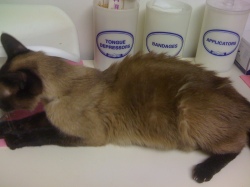
 “My Cat’s Eating All the Time, Losing Weight, and Crying all Night.”
Circe’s (pronounced Sir-Sea) mom beseeched Doc Truli to understand, “I feel like I’m losing my mind. She won’t let me sleep and I’ve tried every kind of food to make her happy, but she’s still hungry.”
Doc Truli examined the 17-year-old skinny seal point Siamese cat. Circe butted her head into Doc’s hand and arched her back with her whippy Siamese tail straight up in the air; she danced on her tippy toes all over the examination table. Doc predicted these signs of friendliness masked extreme nervousness; Circe would erupt in kitty violence if she felt restrained or threatened.
Vertebra bones jutted out along her back. Her big blue eyes looked sunken into her skull. Her skull outlined against the examination room light. Her petite little paws carried half the weight from 10 months before at her annual check up. The little cat’s ribcage stuck out like a spring-loaded drum around her spastic heart beating 300 beats a minute! Circe was one sick cat!
“Circe is very sick. She needs hospitalization and a full medical work-up. My nurse will go over the diagnostic and treatment plan with you before we do anything further,” said Doc Truli.
“How can I avoid putting my cat through all of those tests?”
“But she’s so energetic. She eats. She purrs. Doesn’t that mean she’s not that sick? Do I really need a bunch of tests? Can’t we just start with one test and, if we find the answer, we don’t have to put her through the other tests?” said Circe’s mom.
Doc hears this almost every day. Probably, if you just found VirtuaVet, you are asking yourself the same questions. Maybe you don;t have the money for “lots of tests.” Maybe you’re hoping for some direction without personal data about your cat.
“Here are the reasons she needs all the tests I am prescribing,” said Doc Truli,” First, she lost half her body weight.”
“That’s just this week. That’s why I brought her in, she used to eat anything I gave her and now she just wants to eat the juices from the canned food.”
“She did not lose 50% of her body mass in 1 week. It’s very tricky to notice weight loss in a cat that you see every day. The weight changes are subtle and gradual.”
“My cat can’t be dehydrated. She drinks a lot of water.”
Doc Truli showed Circe’s mom the skin turgor test, so she could see the abnormal skin reaction with her own eyes. Still., it’s hard for someone to believe something so obvious that they never knew before that minute!
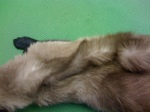
- Can you see the skin never went back down?

“But, do we really have to do all these tests? Can’t we just start with one? I don’t want to put my cat through all these tests!”
Diagnostic Tests for a Sick Cat with Severe Weight Loss
- “Minimum database” consists of Complete Blood Count, Blood Chemistries, and Electrolytes, urinalysis
- Feline leukemia and feline AIDS virus tests, even for cats who are indoors all the time
- fecal parasite examination
- Thyroid Level
- Blood Pressure
- Urine Culture and Sensitivity (15% of cats 10 and older have a hidden urinary tract infection.)
- Full body radiographs (2 views)
- Probably abdominal ultrasound
If You Have Pet Insurance, You’re Liable for Only 10-20% of the Bill!
Probably, depending upon where you live, you’re looking at 1-2 week’s pay. If you live in the US, 3% of you have pet insurance. If you live in the UK or EU, 75% of you have pet insurance. If you have pet insurance, you will spend a few days’ pay, instead of weeks!
Most people at this point say (or think), “That’s too expensive! Isn’t there anything I can do at home to help without spending so much?”
The Two Most Common Misconceptions About Cat Medicine
1. Can’t I just do some tests? and 2. Can’t we just try antibiotics and see if my cat feels better?
No, and no! Okay, honestly, maybe your cat will have the first disease tested for, and no other diseases. Maybe your cat has a deep kidney infection, and nothing else wrong. In that case, a few tests and some antibiotics, fluids, and special feeding instructions might just get you through. Now, while no research proves the likelihood of multiple diseases at the same time, Doc Truli is here to tell you: Cats Get More Than One Disease at a Time!!!
Comorbidity
Circe had Hyperthyroidism, renal disease, hypertension, hypercalcemia, anemia, and now inflammatory bowel disease with bouts of pancreatitis.
This list of ailments is not unusual in an elderly cat. Cats often have comorbidity (fancy doctor word for several diseases that seem to occur together.) There’s even an officially recognized disease called “triad disease” with pancreatitis, hepatitis and diabetes at the same time!
Do you think one test would have helped Circe? Do you think she would have come back to the hospital several times a week for weeks and weeks if one thing was treated at a time? Do you think Circe would be alive, gaining weight, and eating her cat food normally today? No, she would not.
In fact, this cat is still doing well one year after diagnosis. Her hyperthyroidism is under control, her kidneys are stable. The hypertension resolved when the thyroid and kidney disease stabilized. Once her blood pressure came down from 280/160 (!), her appetite returned. Her options for food that helped her inflammatory bowel disease expanded and she was able to discontinue her Budesonide medication for the inflammatory bowel disease.
We never figured out why she had hypercalcemia. More than half of the time, cats have idiopathic hypercalcemia, which means science cannot find the cause. The high blood calcium did complicate the kidney disease treatment. A very good medication to lower the toxicity of parathyroid hormone that is overproduced in kidney disease cannot be used when the calcium and phosphorus in the blood are significantly elevated. Still, Circe improved with the personal, hand-crafted treatment only the full application of medical technology and knowledge can provide.
Circe stopped crying at night. Maybe she had been uncomfortable. Maybe her illnesses were wearing at her sanity. Maybe she had been yowling for help. Persistence, medicine, and patience gave this cat – and her mom – her life back!