Cats and Dogs: Update your Rabies Vaccine and County License
Our holistic veterinarian has heard from several clients about dog and cat Pinellas County pet license enforcement. Animal Control Officers recently went door-to-door on Woodbine Street, and requested County licenses to be presented for inspection. Neighbors found not to have current rabies vaccines and dog and cat licenses had their pets impounded. It can be expensive and emotionally draining to have your pet impounded and subsequently released to your care, so please call us today to get your rabies vaccine and license, or to inquire if you are not sure if your pet is up to date on the license.
Why Do We Have to Have Pet Licensing?
Many people assume the pet licensing laws were invented to generate money for the county. Actually, the laws are put into place as part of a comprehensive rabies prevention public health policy.
Did You Know?
Pinellas County, Florida…”has more dogs and cats licensed and vaccinated for rabies than any other Florida County. This provides the first line of defense against rabies, and it results in more animals being reunited with their owners than in any other Florida County. For more information contact Animal Services at (727) 582-2600.”
Who Needs a License?
Cats, dogs, ferrets, sheep, horses, and cattle who have reached the age of four months old must have a rabies vaccine in the State of Florida.
In Pinellas County, every cat and dog must have a county license. To save taxpayers’ money, since 2009, lifetime county tags/licenses have been issued. This program saves paperwork and money by assigning a unique pet license number and tag to your pet. You pet keeps the same “tag” or “license” for a lifetime, while you pay your licensing fee and send in your paperwork every 1 or 3 years, depending on the age of your pet and the rabies vaccine they received. The fee for the 1 year or the 3 year is $20.
What Can Happen If I Don’t Have the License?
Your pet can be impounded by an Animal Control Officer. Impounding means your pet is taken to the shelter and you cannot have them back until you pay for the rabies vaccine, license, and pay boarding fees at the impound.
To get your pet back from the County Impound, you must also either pay an impound fee, or pay a fee to have an intact pet spayed or castrated, and Pinellas County will waive the impound fee.
Impound Expenses (please refer to Pinellas County for up-to-date and accurate fees: fines and rules subject to change.)
Impoundment fee:
Charges assessed for reclaiming your lost or impounded pet:
- Sterilized pet = $50
- Intact pet = $80
- Board per day = $10
If your pet does not have a current county pet license or rabies vaccination, they will be required at the time of reclaiming your pet:
- License = $20
- Rabies vaccination = $5
When unaltered (reproductively intact) animals are impounded and reclaimed by the owner, an incentive will be offered at that time to have the animal spayed/neutered at a low cost and, in addition, the impound fees will be waived. The boarding fees will still be assessed per each day the animal was in the shelter.
Low-Cost Spaying & Neutering Fees:
- Spay – Dog = $40
- Spay – Cat =$30
- Neuter – Dog =$30
- Neuter – Cat =$20
Get Your Pet License(s)
In summary, be sure your cats and dogs have their up-to-date Pinellas County licenses. The County does enforce the law and your pets do have to have their licenses.
References
Pinellas County Website regarding Animal Services, including licenses
New Custom-Made Chicken Flavor Chew Tablets
Post-Op Painkillers for Small Dogs and Cats
Medicine never tasted this good! We have found the answer for tiny dogs and cats who do not like syringes and pills and yucky medicine. Especially after a major dental procedure or other major surgery. We have medicine made into flavorful Chew Tabs.
Romeo, the long-haired black and white Chihuahua had three rotten molars extracted earlier today. He just scarfed-up a custom compounded chew tablet of post-op pain medication!
“I can hardly believe this little guy had oral surgery and is actually eating that Chewie only a few hours later!” says our holistic veterinarian. “It must taste amazing!”
Our holistic veterinarian Cares About Pain Control
We do not want your pet to experience pain or discomfort. Some pain may be inevitable, after all we also serve as an emergency room for community pets. Rest assured, our primary concern is the comfort and well-being of your pet. Always. These new Chew Tabs deliver good medicine in a tasty, friendly manner.
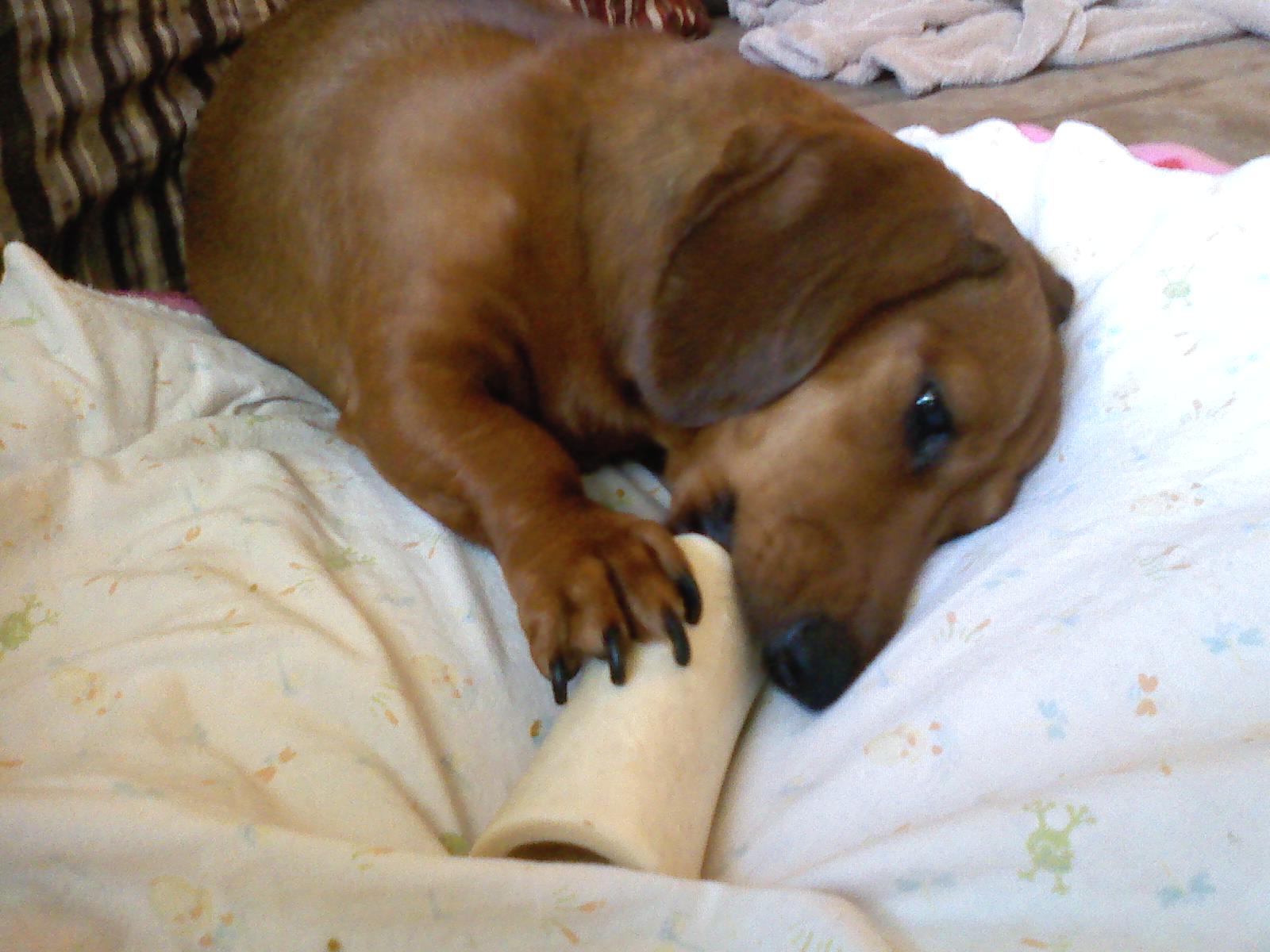
Enjoying her new home and the perks!
Remember Miss Peanut? She was adopted by a client this month!
We just received this awesome photo of Miss Peanut enjoying the perks in her new home! What a happy Dachshund!
We really love what we do!
Trifexis
Trifexis is the most complete dog preventative monthly tablet veterinary medicine has ever seen!
Ever heard of it? The fabulous Comfortis (pronouced Come-FOR-tiss) flea pill for dogs combined with the safe and effective milbemycin= Trifexis(pronounced Try-fex-iss). Now you do not have to give Comfortis and a different heart worm prevention! You can just give one monthly product!
Did You Know?
Trifexis active ingredients are Spinosad and Milbemycin.
Trifexis is a once-a-month yummy flavored tablet for dogs that kills fleas and prevents heart worm infection. It also prevents and controls the intestinal worm infections: hookworms, roundworms, and whipworms.
Call All Pet Care Hospital and ask or mention the new flea and heart worm pill Trifexis at your next check-up to learn the ideal preventatives for your pet. You will save time and money!
Letter to Our Clients,
The most up to date, progressive parasite prevention products include Trifexis, Revolution feline, Advantage Multi, Advantix, Comfortis, Heartgard Plus, Interceptor & Preventic.
We have decided to phase out supplying the following: Advantage and Frontline.
In our attempts to better serve you, we occasionally find it necessary to re-evaluate which veterinary products best fit with our practice standards.
We would like to stress that the efficacy of these products was not a factor in this decision. Our goal in making this change is simply to improve our ability to provide you with the best service possible. Eliminating the above products will allow us to stay on top of new developments in veterinary medicine by making room for newer products as they come to market.
For those of you who wish to continue using these products, Advantage & Frontline are readily available over the counter at the large pet stores. We will happily approve prescriptions, just give us a call and we will help you set up your own online pharmacy account(813) 816-1759
We apologize for any inconvenience this may cause however we believe that our decision will improve our ability to provide all of our clients with the most up to date progressive veterinary care.
Thank you,
Our holistic veterinarian
Trifexis Warning
If your pet undergoes an off-label treatment, typically used for treatment of demodectic mange, with the drug ivermectin, you must not use spinosad, one of the active ingredients in Trifexis. Serious, and possibly deadly side-effects have been reported from the combination of spinosad and ivermectin.
Trifexis Reference
All Pet Care Hospitals Flea & Tick Page
Pharmaceutical Industry Today official news release
Note August 15, 2011:
Many people have been commenting on this website asking about their personal dogs. If you are not a registered client of our holistic veterinarian aka our holistic veterinarian, we cannot answer medical questions regarding your pet. Please, please, call your family veterinarian for personal advice!
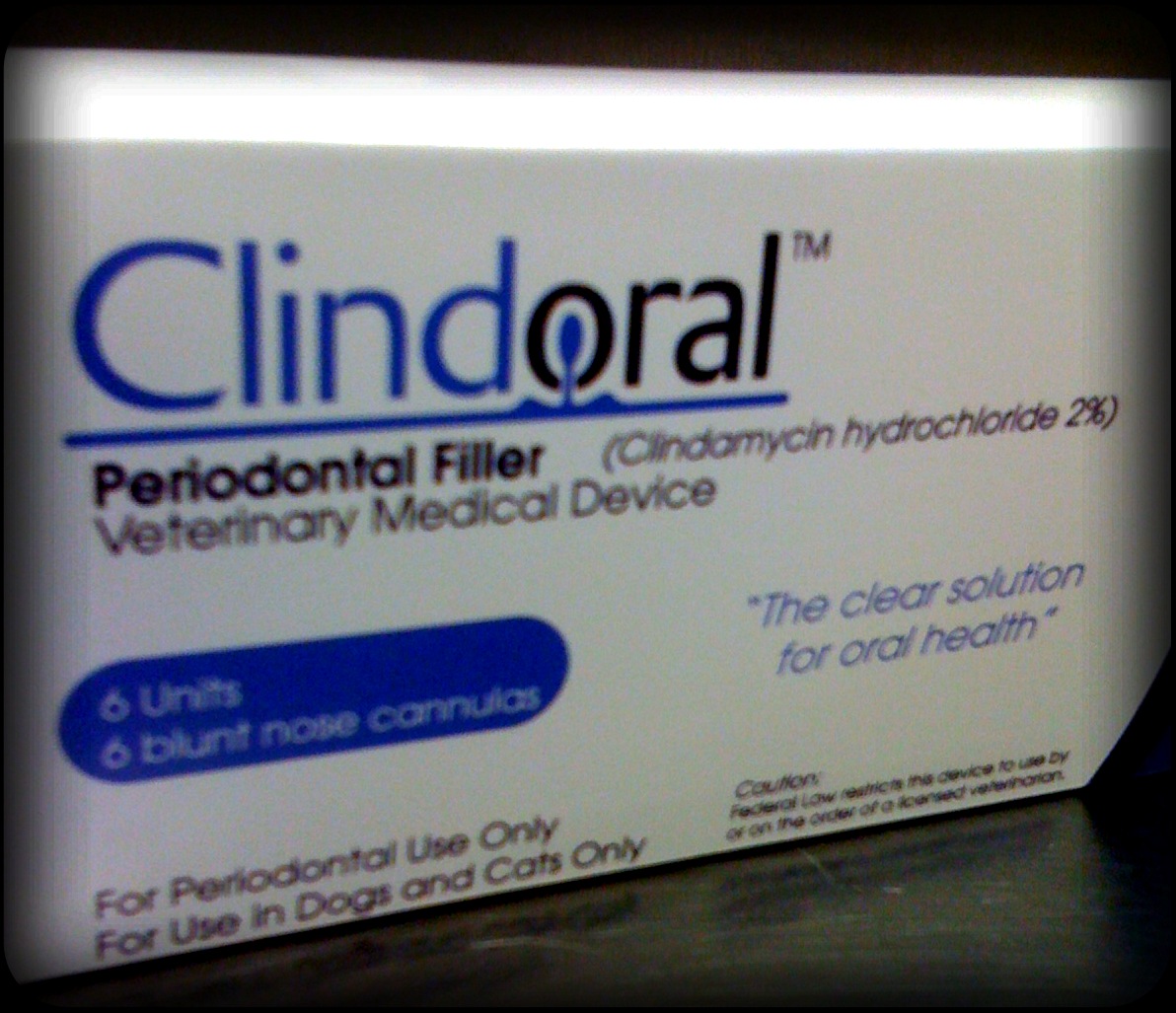
Clindoral Treats Periodontal Stage 2-3/4 Teeth
Clindoral Saves Teeth
The Problem With Pet Dentistry
Here’s the problem: your dog or cat or ferret has terrible breath. You can see yellow-brown calculus clinging to the teeth. You might even see bright red sore gum lines above the yellow tartar. You feel guilty that you waited so long to take care of the problem. You do not want your pet to loose any teeth. You are not a fan of anesthesia. Not for yourself, not for your children, not for your pet.
Did I get that all right? Pretty close? Yeah, I’m good like that.
So, up until now, your vet has put your pet under anesthesia, cleaned the teeth, and maybe pulled teeth that were hopelessly damaged. That’s fairly standard. News flash: There is no way around the anesthesia requirement for proper, effective tooth care in pets. read more…
Harvey the Guinea Pig
Guinea Pigs Need Surgery, Too (Sometimes)
Harvey peered at our holistic veterinarian through the mesh in his carrier door. His
cheeks bulged back and forth as he chewed his Timothy hay. His orange
and white ruffled fur stuck out different directions on hs shoulders
and haunches.
Three children watched their 2 1/4 pound pet and nervously offered
their questions.
“The oldest Guinea Pig I’ve known was Einstein. He lived in Maine, USA. I didn’t believe he was nine. But when we calculated the time since the kids met him as their kindergarten class pet and took him home at the end of that school year, well, nine years had passed!” said our holistic veterinarian. read more…

VirtuaCat
VirtuaCat
Our holistic veterinarian’s Short List of Causes of Sudden Kidney Failure: Get to an Animal Hospital Right Away!!!!!
- Antifreeze – ethylene glycol poisoning
- Lyme Disease Vaccine
- Lyme Disease rickettsial infection
- Leptospirosis bacterial infection
- ***Cats**** (Remember this at Easter and Christmas) – Eating Lilly Plants, any part of the plant, even one bite causes sudden, kidney failure in cats. No cure; they die!
- ***Dogs*** Raisins, grapes and currants. Possible only a few of the fruits could cause it!
“VirtuaCat, being a lazy Himalayan pussums, barely notices floral arrangements on the dining room table. Still, we have a rule in our house: no lilies in or near the property, ever!” says our holistic veterinarian.
Symptoms of Sudden Renal Failure
- excessive thirst and urination
- incoordination, called ataxia (legs not organized right)
- weakness
- nausea and vomiting
- tremors, usually whole body
- rapid breathing and heart rate
- diarrhea
- convulsions and seizures
- paralysis
Read More:
Antifreeze Poisoning
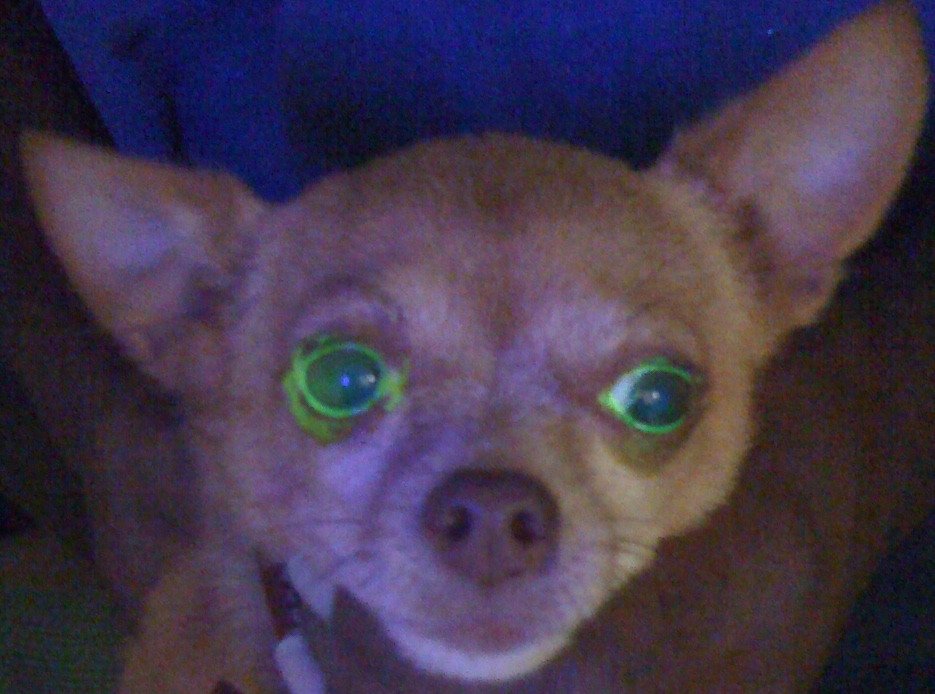 Check this out!
The ultimate dog Halloween “look.”
No, really. This Chihuahua woke up with red irritation in the whites of his eyes. He was blinking and squinting and tearing and it just wasn’t a good situation.
First, little Romeo had his eye pressures measured. Normal. So, no glaucoma! That’s good news!
Nothing looked wrong with the corneas on the physical examination, but before prescribing any medication which could potentially make a corneal scratch or ulcer worse, a fluorescein dye test was needed. (People get this, too!)
The dye looks orange when you open it up. Then, mixed with sterile saline or tears, it turns a green-yellow color. Turn out the lights, turn on a black-light, and viola! Halloween doggie!
“A normal corneal surface on the eye repels liquids and dust and washes away irritating little what-nots that can damage your eyes. If the dye sticks anywhere on the surface of the eye, then you’ve identified a defect in the surface,” says our holistic veterinarian.
Ever get sand or dust in your eye? Hurts, right? Corneal ulcers and scratches are super painful. People even call in sick to work from a corneal scratch. Ask your veterinarian if any of the medication they’ve prescribed helps with the pain.
Romeo’s flourescein dye washed off the eyeball readily. No ulcers or scratches. A plain old cause of conjunctivitis (usually non-contagious in dogs BTW). Some eye drops and a few days out of the sun and Romeo was as good as ever!
