The Constitution, or Personality 5-Element Type, that best fits your dog can help predict strengths, weaknesses, and the kinds of imbalances your pet may be more prone to. The 5-Element framework can help you understand your dog’s personality, choose a compatible companion pet, or prepare for seasonal weather changes.
Traditional Chinese Veterinary Medicine (TCVM) recognizes 5 Elements rooted in Daoist, naturalistic philosophy: Wood, Fire, Earth, Metal, and Water. In TCVM, there are also 6 pathogens — disease-causing influences — named Wind, Cold, Heat, Damp, Dryness, and Summer Heat. These six can knock the body’s regulating balance off course and show up as the symptom patterns TCVM practitioners look for.
The Five Types
WOOD — The General
Strengths: decisive, assertive, strong, athletic, a natural “winner.” Struggles: quick to anger (may bite when frustrated), red eyes, liver-pattern issues, torn ligaments, ear and anal-gland disease. Watch for spring-season flare-ups like seizures, allergies, and itchiness. Green is the color traditionally associated with Wood — though of course dogs come in every color, not just green.
FIRE — The Emperor
Strengths: lively, communicative, affectionate, the center of attention. Struggles: separation anxiety, panic, heart-pattern issues, restlessness. Watch for summer-season flare-ups like skin infections, thunderstorm phobia, and heat sensitivity. Yellow or red are the traditional colors of the Fire element.
EARTH — The Mother
Strengths: laid-back, sweet, tolerant, easy to please. Struggles: worry, weight gain, weak limbs, digestive issues. Watch for late-summer/harvest-season flare-ups like inflammatory bowel patterns, organ prolapse, obesity, and low thyroid function. Orange or brown are the traditional colors of the Earth element.
METAL — The Prime Minister
Strengths: independent, organized, quiet, confident and consistent. Struggles: nasal congestion, lung-pattern issues, asthma, constipation. Watch for fall-season flare-ups like bronchitis and asthma. White or gray are the traditional colors of the Metal element.
WATER — The Philosopher
Strengths: quiet, observant, analytical, a skillful strategist. Struggles: fearfulness (may bite if startled), shyness, kidney- and bladder-pattern issues, arthritis and disc disease. Black is the traditional color of the Water element.
How the Elements Interact
Each element also has a relationship to the others — a Wood-type dog will invigorate a Fire-type companion, prod an Earth-type into more activity, but may exhaust a Water-type. Understanding these dynamics can help when choosing a second dog or managing a multi-dog household’s dynamics.
Why This Framework Matters
The 5-Element system isn’t a diagnosis on its own — it’s a lens. An integrative veterinarian trained in TCVM will weigh a dog’s constitutional type alongside Western diagnostics and physical exam findings to build a more complete picture of what a dog needs to thrive, and which seasonal or lifestyle changes might help prevent flare-ups before they start.
How Ancient Law Pet Wellness Can Help
Diagnosis and treatment of any medical pattern should go through your dog’s veterinarian. Where our team comes in is TCVM Food Therapy — many food-energetic principles map directly onto these constitutional types, so knowing your dog’s type can help us fine-tune a feeding plan suited to their tendencies (cooling foods for a Fire-type prone to heat, warming foods for a Water-type prone to cold, and so on). Reach out at JLaw@VetVmd.com or call/text (813) 816-1759 to talk through your dog’s constitution.
Arthritis feels better with acupuncture
The World Health Organization recognizes acupuncture as a scientifically-based treatment for many human ailments.
The criteria for inclusion in the report were determined in Cervia, Italy in 1996 by the World Health Organization.
Alternative Lump Removal for Dogs
So your dog has tiny bumps and lumps. The vet says you can leave them if they don’t bother your dog. Then the hairbrush clips one and it bleeds a little. But it stops and nothing changes. Then one grows on the paw and your dog licks at it. Then one grows on the top of your beloved’s head and your hand catches on it every time you put your dog on the head. Which is every day. Probably every waking hour that you are home. (What can I say? Our dogs are spoiled!)
Still you think, it is not worth another trip to the vet. You already had the lumps checked. They are “nothing.” or “adenoma-like” or papillomas or warts, or, something you don’t say out loud for fear of pronouncing it wrong. So what else can be done?
Cryoablation Surgery
If a lump is tiny. If it is not cancerous. If your dog will sit still for a minute or two. If the lump is on the skin and not under the skin, cryoablation may be a good option for you.
What is cryoablation surgery?
The quick answer: cryoablation is freezing the lesion to kill the cells. They slough off and the lump is gone in about 2 weeks. Or very nearly gone.
The bigger answer: cryoablation uses a proprietary, highly optimized formulation of refrigerated gases for your medical professional to use in an outpatient setting to freeze a lesion down to -70°C (-94°F). Basically, the veterinarian gives a lump frostbite. This can be done in a house call!
There are custom size directing cones and buds to apply the freeze that fit many different size dogs and lesions.
Who qualifies for cryoablation surgery?
Any dog with unwanted skin lump(s) that are noncancerous
Elderly dogs with higher than normal anesthesia risk
Families with a dog with lumps that do not want anesthesia, drugs, or scalpel or laser surgery
How long does cryoablation surgery take?
The freezing procedure takes 3-6 seconds. The unwanted skin lump or tag will continue to freeze for several minutes after application of the freezing gases.
What is cryoablation surgery recovery like?
The lesion(s) likely swell for a few days. Then they begin to ooze a little clear, odorless material. Then they form a crust (scab) that you must leave in place to form a biological bandage. The crust falls off in about 2 weeks.
How much do I need to budget for cryoablation surgery?
This is a medical procedure performed by a trained, licensed veterinarian in the comfort of your home. You must be a registered client, with a current physical examination so that the doctor can assess your dog’s suitability for cryoablation. The procedure itself generally costs $150 to get started with the first lesion. Additional lesions can be treated in the same day. For example, a recent patient had a house call, physical exam, cryoablation of 3 lesions and that cost under $500. (Surgery generally costs around $500 just for the anesthesia-related expenses.)
Call, text or email Dr Truli for an appointment!
Dr Sandra Truli Springer, VMD, CVA, CVFT, CVTP provides house call holistic services to the Tampa Bay Area. Please contact the doctor with your name, address, and request for your pet to discover scheduling availability. Dr Truli’s practice is 100% house calls. These consultations are thorough, reassuring and professional. Dr Truli will evaluate your dog and discuss cryoablation with you. If cryoablation surgery is a good choice for you, she will be prepared to perform the medical procedure in the initial consultation visit, with no need to reschedule. Email DrTruli@VetVMD.com or Text (877) Dr Truli | (877) 378-7854.

Is Your Dog Cool-Seeking? Traditional Chinese Veterinary Medicine Wants to Know
A Traditional Chinese Veterinary Medicine (TCVM) doctor will ask, “Is your pet heat-seeking or cool-seeking?” You might just think, “What do you mean?”
The dog in the picture makes his point obvious: of all the places in the yard to lounge, he lays on the block of icy snow that has not yet melted in the Spring thaw. There are obvious signs that your dog is excessively cool-seeking.
Signs your dog is cool seeking
Your dog may show one or more signs:
- Lays on cool tile floors, even if it means they are away from the family
- Takes a long time to cool down after going outside in the heat
- Pants for no reason most of the day
- Symptoms seem worse in the evening: coughing, limping, restlessness, itchiness may be worse in the evening
- Drinks more water than usual, often going back for more many times a day
Tru Tip: How much is too much water?
Many people ask Doc Truli this question. A general guideline is 30 mL per pound (1/2 kg) of dog per 24 hours is a maintenance amount of water for an average activity house dog. So a 50 pound (25 kg) dog may drink a liter and a half. If you are in America- think of a 1 1/2 of a liter water bottle to get an idea of how much water that is. (The test of the world knows how much already…) Your veterinarian can help you determine if your dog’s water intake makes sense given their lifestyle and activity level.
Measure how much water your dog drinks for 3 random days and average the amount. If it seems much more than we just described, let your vet know. If your pet seems sick, see the vet right away and measure the water after the consultation.
- Likes to sleep in front of the fan or air-conditioning registers
- Used to sleep in bed with you, now throws off the covers or moves to the cool floor instead
- Usually an older pet
- Often a pet with Diabetes Mellitus, Cushing’s Disease or other endocrine or hormonal imbalances
- May have hot dry nose and ears, may have dry red tongue
- May still sun-bathe for a few minutes a day. The sun offers benefits that out-weigh your pet’s desire to cool off.
If you notice these signs, notify your veterinarian right away. To find a TCVM practitioner near you go to The Chi Institute Directory of Practitioners or The American Holistic Veterinary Medical Association Directory.
If you live in the Tampa Bay area of Florida, USA, call Dr Truli to inquire if a house call appointment is available for your area: (727) 228-2265.
House Call Acupuncture for Pets
Seeing is believing. These pets are enjoying their acupuncture treated provided by Dr Sandra Truli Springer. Dr Truli (as she’s known to her patients) is a Certified Veterinary Acupuncturist (CVA.) CVAs are granted to licensed veterinarians only. The Certification is rigorous and includes 130 hours of continuing education, 30 hours of internship with experienced acupuncturists, and formal Clinical Case Reports.

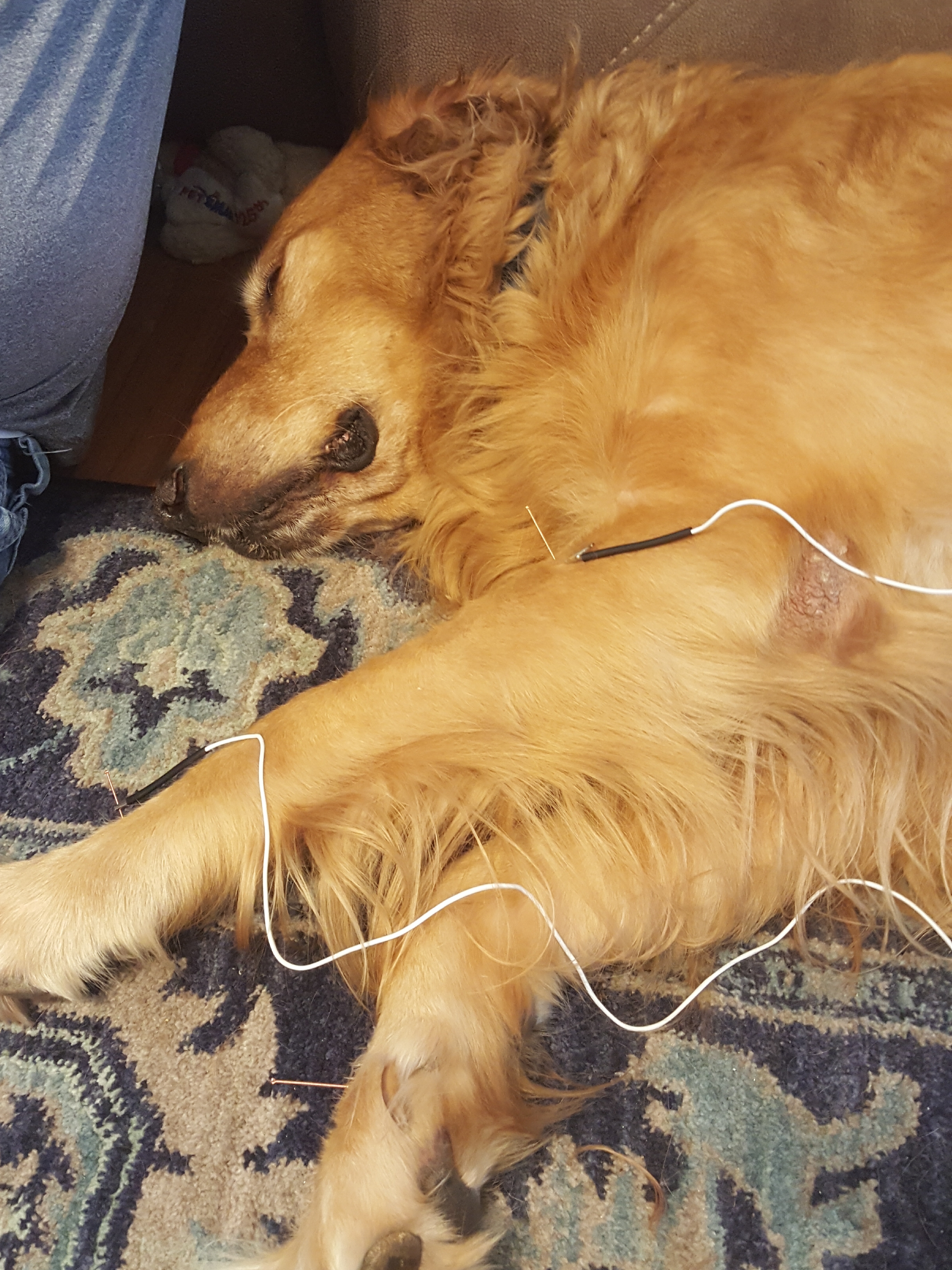
Needles in neck and legs are hooked up to the electro-acupuncture machine to treat paralysis
Acupuncture for Miniature Schnauzer Intervertebral Disc Disease and Hemiparesis
This Miniature Schnauzer was suddenly paralyzed on his right side by a bulging intervertebral disk in his neck but he could still feel pain stimuli in his toes. Standard medical advice was painkillers and 4-5 weeks of cage rest. After 3 acupuncture treatments spaced 3-4 days apart, he is standing up, sitting, and sometimes rocketing across the living room before tripping on the right side.
Acupuncture is clinically proven to help speed recovery from intervertebral disc disease and to help with pain relief.
You can see how he lays on his side for the treatment. Normally, he is super playful and silly. He feels so relaxed from the acupuncture that he settles and sleeps for his treatments. One-third of acupuncture patients sleep through the treatment.
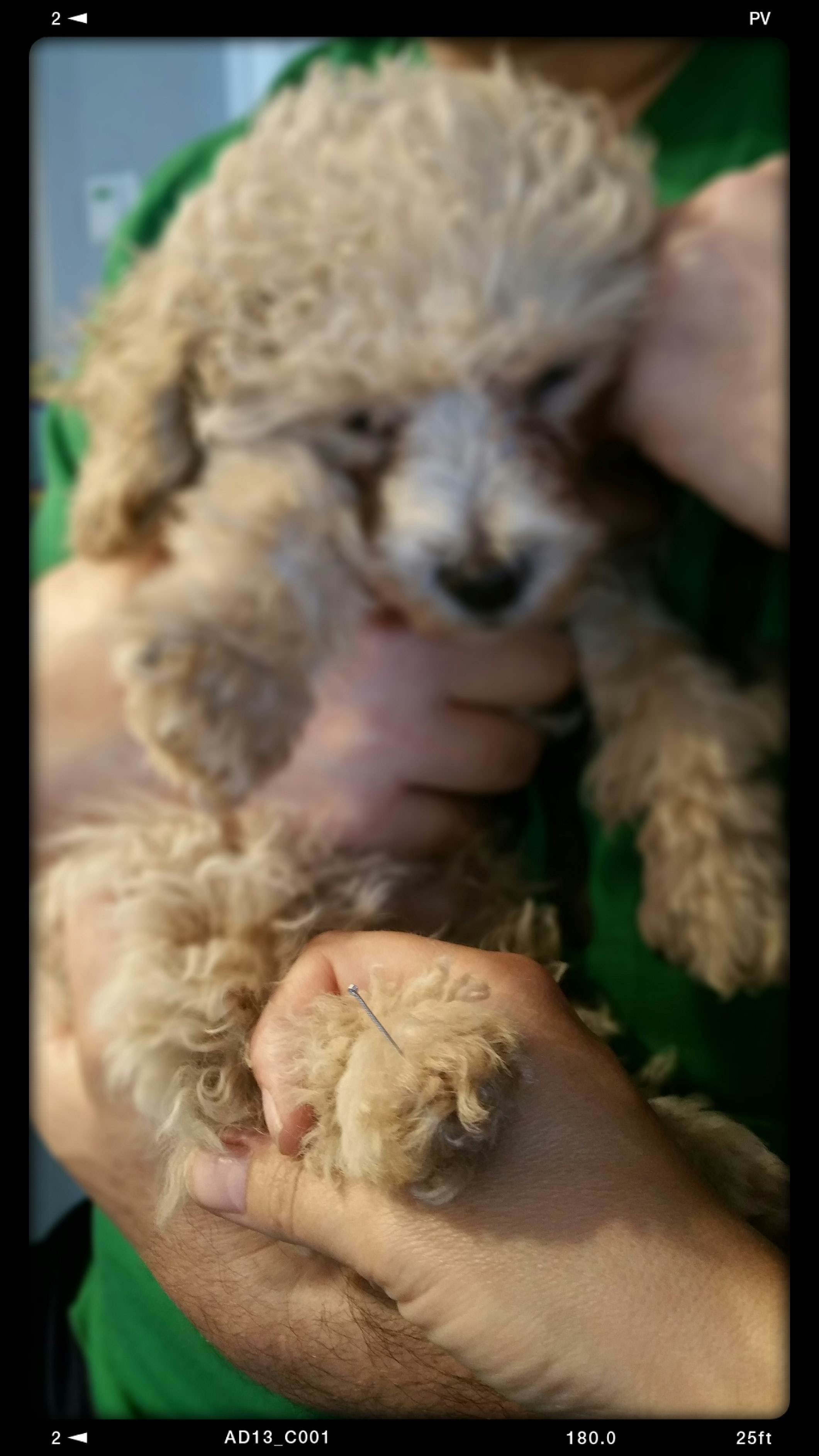
See the pink needle in his hind foot?
Acupuncture for Sudden Onset Bloody Diarrhea in a Miniature Poodle Puppy
This little guy had bloody diarrhea. He is usually a rambunctious, playful puppy. He fell asleep during his acupuncture treatment. His condition resolved with one acupuncture treatment consisting of one needle placement.
One-needle acupuncture is a new technique to veterinary acupuncturists in the United States. Dr Bruce Ferguson introduced Topographic Acupuncture to veterinarians studying at the Chi Institute in Reddick, Florida in Spring, 2017. Dr Truli is one of the first veterinarians in the United States to learn Topographic Acupuncture from Dr Ferguson.
This advanced system of acupuncture takes physical examination findings, symptoms, and history of the pet to determine which one to three acupuncture points on the body will be most effective at relieving many or all of the pet’s symptoms.
How can this be? Well, the acupuncture points are organized along lines of fascia and connective tissue. Approx 85% of the acupuncture lines also follow pathways of nervous system structures like nerves and spinal cord. But not all of them! They are interconnected in specific, known patterns. Knowledge of those patterns, combined with the physical examination allows a specially trained and experienced veterinary acupuncturist to treat your pet with very few needles.
How do you know it is working? Your pet may relax, yawn, fall asleep. sigh, stretch out, and we can see the relaxation and pain relief. Restricted joints, like hips that do not flex and bend will bend or extend, often within minutes of the start of treatment. Dr Truli can demonstrate for you in your house call where your pet is experiencing lack of proper mobility or flexibility or pain, apply the acupuncture needles, and then demonstrate return to normal or near-normal function. This system of Topographic Acupuncture is especially useful for sensitive, fast-moving, older, or pediatric patients as it is not over-whelming to them.
Traditional Chinese Veterinary Medicine (TCVM) has been practiced for more than 2,000 years and incorporates food therapy, tui-na (physical manipulation therapy), acupuncture, and Chinese Herbal Medicine (CHM). Historically, food therapy has always been the foundation — but herbal medicine plays a major role too: roughly 70% of patients in China are treated with herbs alone or herbs combined with acupuncture, and only about 30% with acupuncture alone. Clinical studies support Chinese Herbal Medicine for a wide range of conditions, from dermatology and gastroenterology to cardiology, oncology, behavior, and sports medicine.
What Makes Chinese Herbal Formulas Different
Chinese herbal formulas combine whole herbs — often one to ten or more ingredients — chosen to work together, amplifying benefits while minimizing side effects. Research over the past thirty years shows these combination formulas tend to outperform single herbs or untested Western-style extracts. Acute issues (like a “garbage gut” upset or a urinary tract infection) often respond within one day to four weeks; chronic conditions may take one week to six months. Senior or immunocompromised pets often benefit from ongoing maintenance support.
Are There Side Effects?
Herbs are drugs, and potent ones. Used properly under a trained TCVM practitioner’s guidance, side effects are uncommon — roughly 5% of pets may have mild stomach upset (diarrhea or vomiting). Pets on Western cardiac drugs, diuretics, anti-diabetic medications, anti-hypertensives, or blood thinners should be monitored closely, since some herbs share similar actions. This is exactly why sourcing and guidance from a trained TCVM practitioner matters — unlike acupuncture, which tends to help restore balance without pushing the body in one direction, herbs “push.” An arthritis formula meant for heat-type arthritis will not help — and may worsen — cold-type arthritis. Proper pattern diagnosis first is essential.
Sourcing Quality Herbs
Our herbal wellness guidance draws only on top-quality herbs from Jing Tang Herbal in Reddick, Florida — independently tested for heavy metals, pesticide residue, moisture, and bacteria, with full traceability and no endangered species or banned substances like ephedra.
Forms Chinese Herbal Medicines Come In
Teapills, patent pills, 0.2g and 0.5g capsules (standard and concentrated), loose powder, concentrated powder, topical salve, and essential oils.
Routes of Administration
Oral (with or without food, cooked or raw, liquid or solid, baked into biscuits or treats), topical, rectal (last resort — consult your holistic practitioner first), moxibustion, soaking into paw pads, and aromatherapy (experimental).
Giving Herbs to Dogs
Most Chinese herbal medicines are given orally. Capsules can be opened and sprinkled into food or fed whole; many formulas can be cooked into food or baked into biscuits (Jing Tang Herbal even offers ready-made biscuits for common formulas like External Wind™, Body Sore™, and Damp Heat Skin™). Teapills can be crushed into food or melted in a small amount of water or broth and given by dropper or oral syringe.
Team tip: one client’s Welsh Terrier preferred her teapills tucked inside a pitted olive — which, in her case, was also a fitting bit of food therapy.
Giving Herbs to Cats
The same principles apply — capsules opened into food, teapills crushed or melted in 1-2 teaspoons of water (any more, and you’re forcing a larger volume of liquid on a pet who’s already resisting). Some cats do best with a teapill hidden inside a chicken heart. Others will tolerate herbs mixed into coconut oil smeared on a paw, which they’ll lick clean — though check with your holistic practitioner first, since this isn’t right for every cat or every herb. Powder can also be sprinkled lightly on fur for a cat that grooms itself regularly (skip this for sick, disinterested, or wounded pets, or pets with allergies, since some herbs can stain fabric and bedding).
All of these techniques are starting points to discuss with your holistic veterinary team — every pet and every formula is different, and getting the details right avoids mishaps and ensures the treatment actually works.
Further Reading
- Chinese Herbal Medicines: From Historical Legends to Medical Practice by Xiaolin Deng, OMD & Aituan Ma, MS, PhD, Chi Institute Press, 2016
- The Divine Farmer’s Materia Medica (Shen Nong Ben Cao Jing), translated by Yang Shou-zhong, Blue Poppy Press, 1998
How Ancient Law Pet Wellness Can Help
Our Herbal Wellness Protocols service guides pet parents through sourcing, safe administration, and pattern-appropriate herb selection in partnership with your prescribing veterinarian. Reach out at JLaw@VetVmd.com or call/text (813) 816-1759 to learn more.
Hi There!
Manchester Terrier Hates Thunderstorms
Manchester Terrier has Bad Start in Life
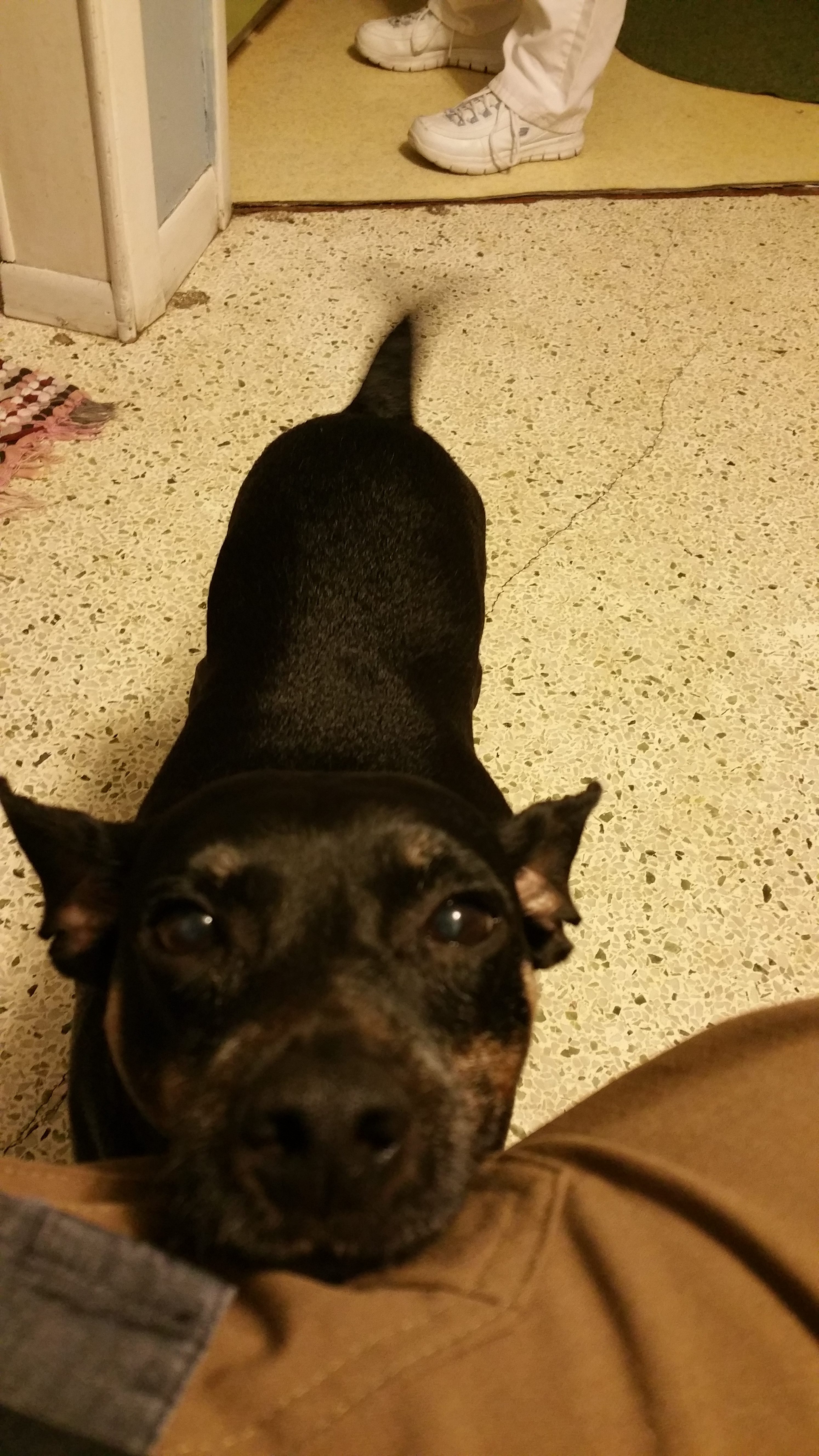
“It was just terrible,” says Buddy’s person of four years, “You wouldn’t believe the filth and neglect he lived in at the junk yard where I got him.” Meet Buddy. The 7-year-old black and tan 35 pound (17 kilo) Manchester Terrier wagged his tail so fast I couldn’t see it. He shoved his nose against my pant leg and tried to crawl into my lap as I sat at the antique carved mahogany dining room table. Luckily, the Persian rug gave him enough grip that his long toenails did not slide out from under him. Over-all, the feeling was happy chaos. Buddy pushed his black and white Pit Bull Terrier friend, Shady, aside, even though she weighed twice as much as he did.
“Now Buddy, let the doctor do her work,” said Marlene, Buddy’s person. Marlene has been rescuing animals since before people called it rescue work. She started with Pit Bulls the courts ordered destroyed in the 1980’s, horses too lame to walk, and Guinea Pigs dropped on the pet shop doorstep with bumble foot and starvation. As a holistic house call veterinarian, Dr Truli was a perfect fit for Marlene’s crew of rescue creatures.
“Marlene, I know I’m here to see Spike (Guinea Pig with viral eye infection from wild rats.) But I am concerned about Buddy’s redness in his eyes. He looks like he could have dry eyes.”
“Oh, yeah, well why don’t you check him out?” Marlene agreed.
Wood Constitution Bossy Dog Health Problems
Buddy was a bossy, stubborn, physically active, moody and loving guy that sometimes caused Shady the Pit Bull to lose her patience and tag him with a little bite.
“You know,” said Marlene, “I have to put him to bed under the covers if there’s a thunderstorm. He just loses it. And remember those liver enzyme elevations from a few years ago when we did blood work?” Marlene is a registered intensive care nurse. She remembers details like that.
Wood Constitution dogs are athletic, bossy, can be aggressive when they are frustrated or angry. They are loving and attentive when they are happy. Wood types are prone to Liver Qi Stagnation-related health problems. Stagnation causes Heat in the body. Heat rises up to the eyes to dry them out and the head to predispose to seizures (according to Traditional Chinese Veterinary Medicine theory.)
“Oh, wow! You know, I do remember now. Buddy needs to calm his emotions. He gets too heated up emotionally and causes himself to get dry eye and panic attacks during the storms. He is at risk of developing seizures if he keeps going like this,” said Doc Truli.
Herbal Medicine Treatment for a Wood Constitution Dog with Dry Eyes, Seizures, and Storm Phobia
We ordered Buddy Liver Happy (TM, Jing Tang Herbal) Chinese herbal remedy to soothe his Liver Qi and help him keep his emotions cool, calm and collected. Before the order arrived in the mail, Marlene called Dr. Truli.
“Buddy had a seizure last night!!!!! What do we do?” said Marlene.
“We are just in time. The Liver Happy remedy will help with the seizures and the dry eye,” said Dr Truli.
Herbal Medicine Helps Manchester Terrier Feel Healthier
After 6 months of Liver Happy, Buddy has no more seizures at all. His eyes are clear without using eye drops. His liver enzymes are still elevated, but they stay stable. He handles Thunderstorms without trying to start a fight with Shady the Pit Bull. He’s still a bossy know-it-all. But that’s what we like about him!
Chinese herbal medicine is available from a licensed veterinarian with advanced training in the diagnosis of Chinese health patterns and the uses of the Chinese herbal medicines. Dr. Sandra Truli Springer, VMD, CVA, CVFT (aka Doc Truli) studies with Dr. Xie at the Chi Institute (TCVM.com) in Reddick, Florida and practices Traditional Chinese Veterinary Medicine in the Tampa Bay area, Florida exclusively through concierge pet care provided in your home. If you do not live in Florida, USA and cannot travel here, you can research TCVM veterinarians in your area at the resources page of the Chi Institute. If you would like to inquire about scheduling an appointment, call Dr. Truli at 877 Dr Truli (877) 378-7854.
Traditional Chinese Veterinary Medicine Gives Results When Steroids and Antibiotics Cannot
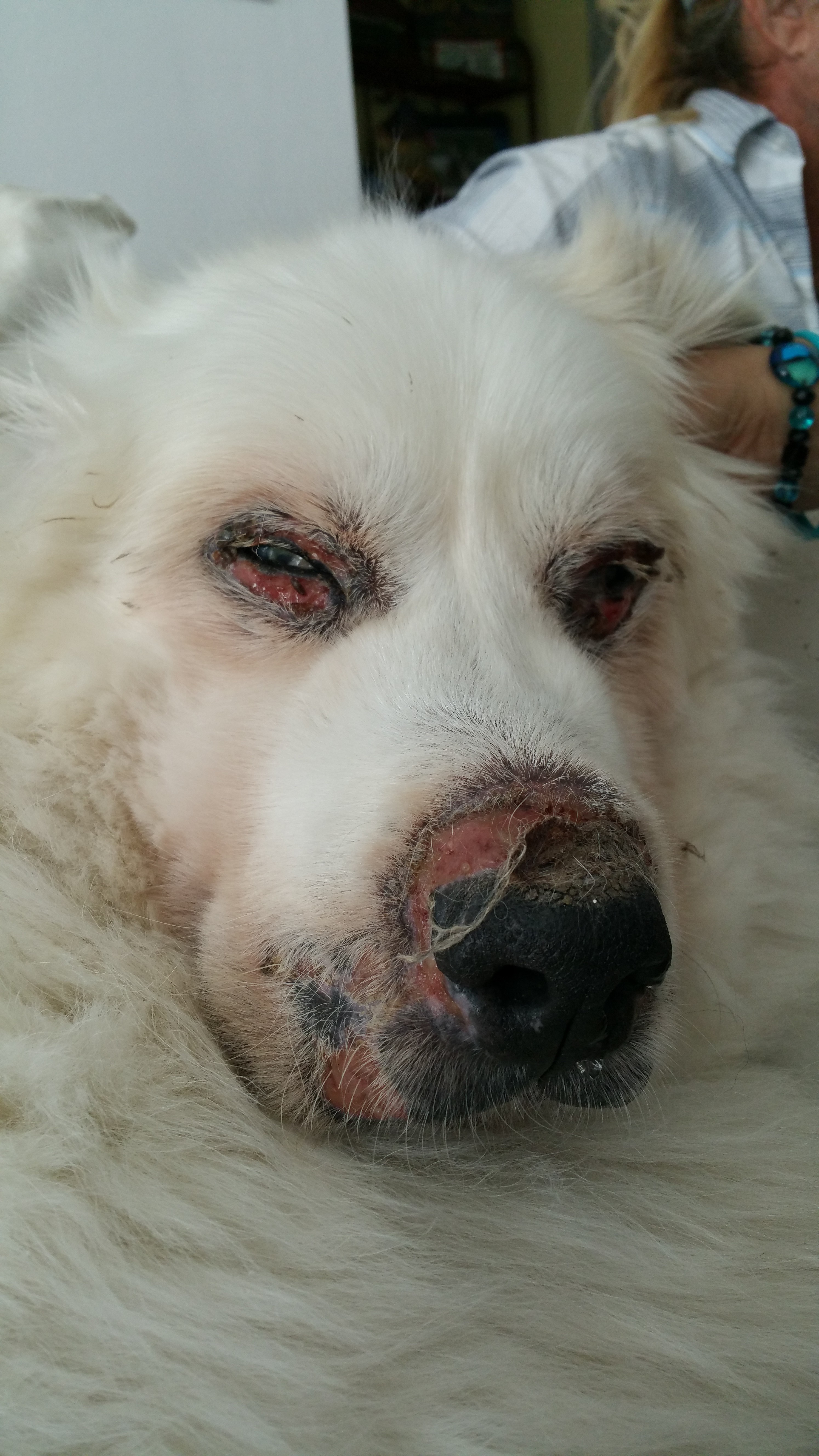
Max was sick for years. Specialists suspected pemphigus autoimmune skin disease.
What is wrong with Max?
Skin is healing. No more bleeding and crusts. Scars are inevitable!
Max had years of scabbing and bleeding at all the mucocutaneous (pronounced mew-ko-cue-tane-ee-us) junctions of his body. These are areas where haired skin meets the sensitive smooth lining skin at the nose, eyes, lips, anus, prepuce, and paw pads. They all hurt and cracked and bled. He spent much of his days asleep or rubbing his face along the walls to sooth himself. His people had taken him to nine (9) veterinarians in the few short years before he met Doc Truli, including board-certified dermatologists for dogs. Skin tests and cultures ruled out infections and common problems and skin surgical biopsies came back with inconclusive results. (This can happen, especially with long-term skin disease.) Specialists suspected Max suffered from autoimmune skin disease, such as pemphigus foliaceus (pronounced pem-fi-gus foal-ee-aa-shus) but could not prove it conclusively on any tests.
Traditional Chinese Veterinary Medicine Pattern Diagnosis (TCVM)
New Balance of Comfort- no scabs or bleeding!
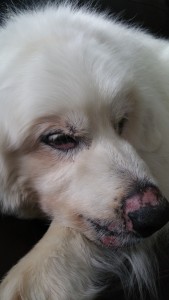
Part-way healed. See the pink healthy skin?
Excess Heat
We approached Max’s conditional from the perspective of Traditional Chinese Veterinary Medicine (TCVM). First, he clearly had too much “heat” in his body. Blood, red, hot, dry, panting, wanting to sleep in the air-conditioned house. According to TCVM, we needed to cool his energy.
Deficient Cooling
He was also deficient in his own internal ability to cool his body. As you can guess, normally, a body will balance the heat and cool. You can add or take off some clothing layers. Turn on the heat, or a fan. Drink iced-tea and eat watermelon, or drink hot chocolate and eat roasted lamb. We energetically balance our bodies all the time. In Max’s case, none of it helped. He just could not cool down and stop spontaneously bleeding. Why? He was deficient in his own internal cooling and moisturizing ability- called the yin energy in TCVM. Max needed his yin energy to balance the hot yang burning-up feeling he had. He just did not have enough internal cooling to manage to pull it off!
The yin What?
In TCVM, everything can be described in balanced terms of yin and yang. Yang is energetic, hot, fast, upward, strong, loud, summertime, teenage years, mid-day. Yin is quiet, dark, cool, solid (substantial), inward, night-time, old age, Winter.
How did we help Max decrease the heat and increase his internal cooling?
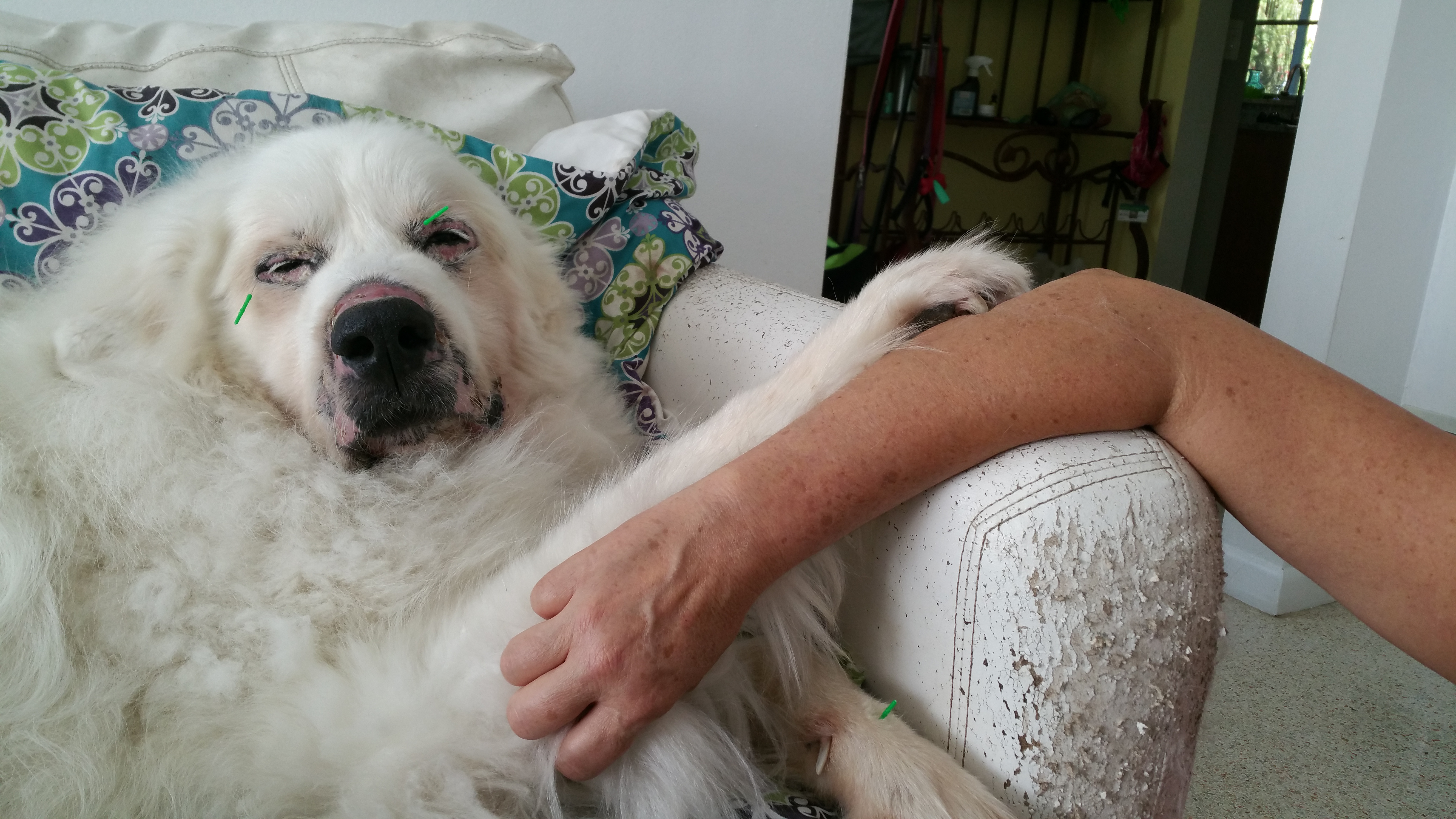
Max chills during his house call acupuncture
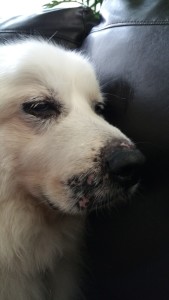
Max’s nose, eyelids and muzzle are 100% healed
First, we simply stopped giving him foods that increase heat in the body. Lamb, venison, shrimp, chicken. Especially chicken!
We added foods, Chinese herbal medicine, and acupuncture treatments to clear heat, boost cooling and moisturizing, treat pain, support the organ functions for detoxification and supporting normal balance and healing processes in the body. He became mostly vegetarian (like his humans), with specific foods and herbal formulas chosen to counter his particular imbalance.
I am not going to list his diet here because you need a licensed, experienced veterinarian who practices TCVM to do this right, the same way you need an experienced healer to help a women through symptoms associated with menopause. We learn from Max that TCVM can help in these seemingly hopeless situations. Reach out and find help from a TCVM veterinarian! In the Tampa Bay area, Dr Sandra Truli Springer would love to hear from you! (877-378-7854)
Doc Truli Helps Australian Cattle Dog Without Touching the Ear
Ever wonder if there is any hope at all for a pet who does not let anyone touch their ears? Doc Truli explains at VirtuaVet.com how it may be possible through Traditional Chinese Medicine to help an otherwise hopeless case. Go to Doc Truli’s Inspirational Pet Medical Story.
If you would like integrative care for your pet in your home, please contact Dr. Sandra Truli Springer today. She sees patients in house calls all over the Tampa Bay area. Phone: 877-378-7854 or email DrTruli@VetVMD.com