Insufficient or Deficient Vitamin D3 Hinders 75% of Dogs in the United States

Dogs & cats need adequate vitamin D3 to be healthy
What is Vitamin D?
D3 is a fat-soluble vitamin that acts as a hormone in the body. Whole food sources include oily fish, eggs and liver. Humans can make D3 from the sun through skin exposure, our companion animal dogs and cats cannot. Cats and dogs can only obtain D3 from food sources.
How likely is my pet to have low Vitamin D?
Vitamin D3 is commonly added to pet foods as part of making the food complete and balanced. And yet, for reasons not yet understood (as of 2021), 75% of pet dogs in the US have insufficient or deficient D3.
What Happens if My Dog or Cat has Low Vitamin D3?
Broadly, insufficient Vitamin D3 causes the body to be in an inflammatory state, promoting allergic tendencies. Low D3 is also found in pets diagnosed with cancer. Conditions such as protein-losing enteropathy and protein-losing nephropathy have a worse outcome if D3 levels in your pet are not addressed. Pets taking steroids, non-steroidal anti-inflammatory drugs like certain painkillers, older pets, and neutered or spayed pets are known to have reduced Vitamin D3 levels compared to young, healthy pets.
“Why not just supplement my dog with Vitamin D3?” you may ask.
Excess D3 causes kidney failure and death. As a fat-soluble vitamin, excess D3 builds up in the body and causes Vitamin D poisoning and eventual death. A top reason for a pet food recall is excess Vitamin D. Home cooked diets are often critically low in Vitamin D, especially if they have not been designed with the help of a veterinary nutritionist.
What Can be Done About Vitamin D3 for my Dog or Cat?
You can fix the Vitamin D3 level with your veterinarian’s help. There are underlying diseases and medications that cause a pet to use more Vitamin D than expected and there are cofactors needed for proper absorption of the Vitamin D3. Your veterinarian can help guide you to a proper dose and monitoring of the dose to make sure your pet stays at an optimal level. Veterinarians and intrigued pet owners can read more about the science and details at VDIlab.com.
How Do I Get the Vitamin D3 Test for my Cat or Dog?
Dr Truli Routinely Performs Vitamin D3, Magnesium & Omega-3 Fatty Acid Level Testing
If you are accepted as a registered client with Dr Truli, you will be offered Vitamin D3 and Magnesium level testing routinely as needed depending on your pet’s underlying health status. In addition, Dr Truli recommends OmegaQuant Omega-3 Fatty Acid testing for Dogs. These tests can often help your pet even more than a routine CBC-Chem with actionable information to make positive changes in your pet’s management at home.
Reach Out Today
If you live in- or travel- to the Tampa Bay, Florida area, you are welcome to contact Dr Truli about becoming a registered client. You can text (813) 714-7863, call (877) 378-7854, or email DrTruli@VetVMD.com. Please include your name, address, your pet’s name and the urgency and nature of the need for services.
Dr Sandra Truli Springer , aka Dr Truli, is an ivy-league veterinarian licensed in Florida and several other US states to practice medicine for animals. In addition to university and 4 additional years of medical veterinary training, she has undergone 5 years of Master’s of Traditional Chinese Veterinary Medicine training and earned the Master’s Degree. She has been practicing veterinary medicine since May 17, 1999. Dr Truli has been practicing exclusively house call integrative medicine since 2015.
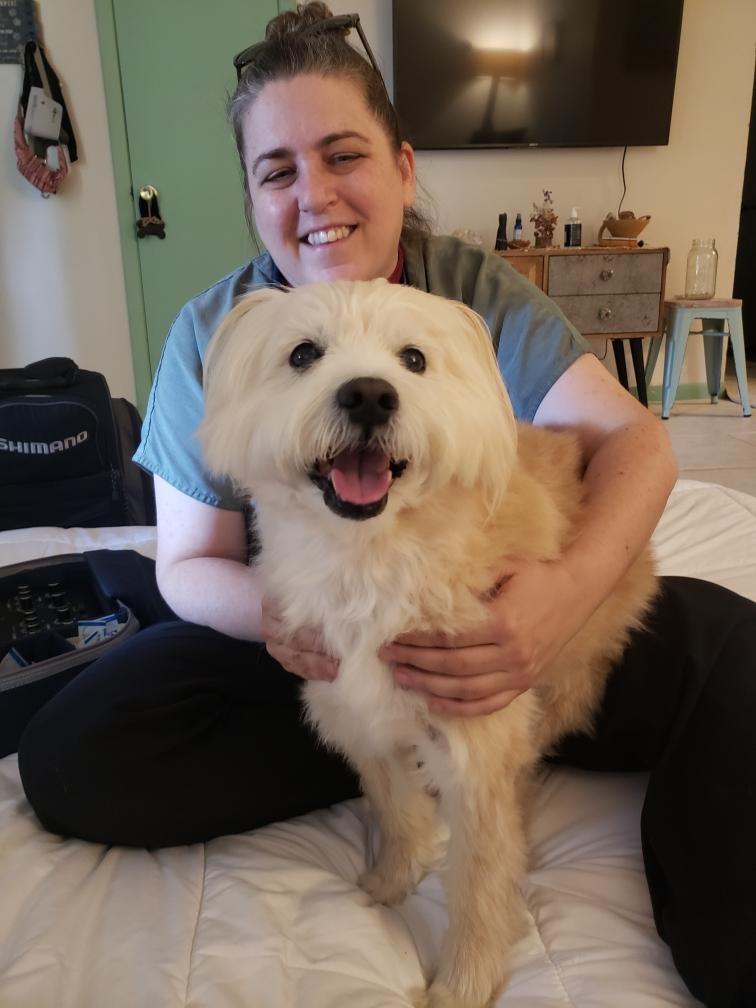
Big doggy smile during acupuncture!
Food Allergy Elimination Diets Can be Tricky
As anyone who has suspected their dog has a food allergy can attest, we wish there were accurate saliva or blood tests to make the food allergy diagnosis easy. However, the interpretation of these tests is unreliable. Saliva or blood tests for food allergies may not be as helpful as we would like.
The gold standard for dog food allergy testing is an allergy elimination diet. You can learn a step-by-step allergy elimination protocol here.
5 Common reasons a “perfect” dog food allergy elimination diet trial fails
The usual reasons a food allergy elimination trial fails:
- lack of committment from everyone in the family
- food falling from the table, especially with little kids in the house
- dog steals cat food. or kitty “snax” out of the litter pan or the garden
- medication or supplements with unsuspected allergens, like “real beef flavor”
- neighbors/friends giving biscuits you do not know about
An unusual reason a dog food allergy elimination diet had to be restarted from the beginning

My friend Benji
Let me introduce Benji. Benji is a much beloved mixed breed long-haired blonde. He has every attention and care that a devoted human can provide. Three weeks into his eight week dog food allergy elimination trial diet, Dr Truli received a text unlike any other.
“Omg Benji ate a piece of styrofoam”
“He ate a whole one of these pieces”
Omg my dog ate a foam packing peanut
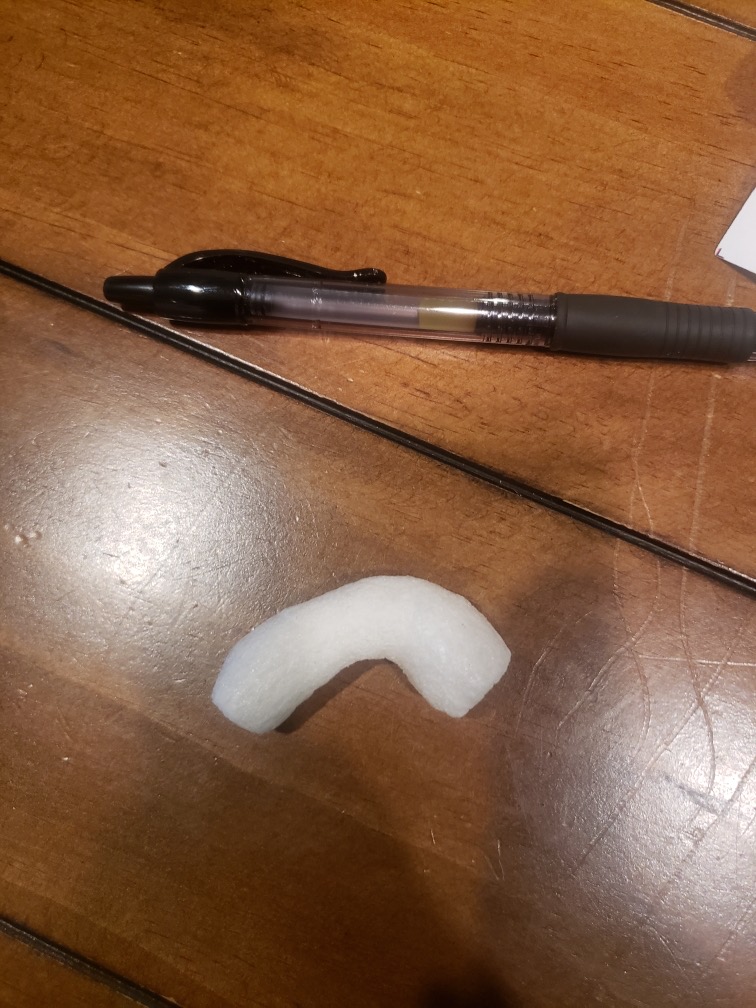
Doc Truli advised Benji’s mom to apply water to the foam packing peanut and see if it melted. It did!
The Good News and the Bad News
Good news: not a foreign body obstruction.
Bad news: possible break in Benji’s dog food allergy elimination diet.
Turns out, these packing peanuts are made of planet-friendly starch. They melt in water and do not add to landfills or waste disposal problems.
However, the starch comes usually from sorghum or from corn. We suspected Benji is allergic to corn! This little “snack” of packing material was a violation of Benji’s dog food allergy elimination diet protocol. We had to restart his 8-12 week “clean” diet in case the packing material was made of a starch that triggered his allergies.
Doc Truli Learned Yet Another Way a Dog Food Allergy Elimination Diet Can be Messed-Up
Turns out, environmentally-friendly packing peanuts can ruin a dog food allergy elimination trial! Let’s keep those packing “peanuts” away from your allergic dog.
Acknowledgement: Special thanks to Benji and his person Liz for the learning experience, beautiful pictures and permission to share this story. -Doc Truli September 1, 2021, Palm Harbor, Florida, USA. To schedule an appointment email DrTruli@VetVMD.com.
Dogs and Cats are Great in a House Call
It’s the Kids That Need Some Guidance

Happy Puppy in a holistic vet house call
Dr Truli can teach you how pain management can benefit your pet
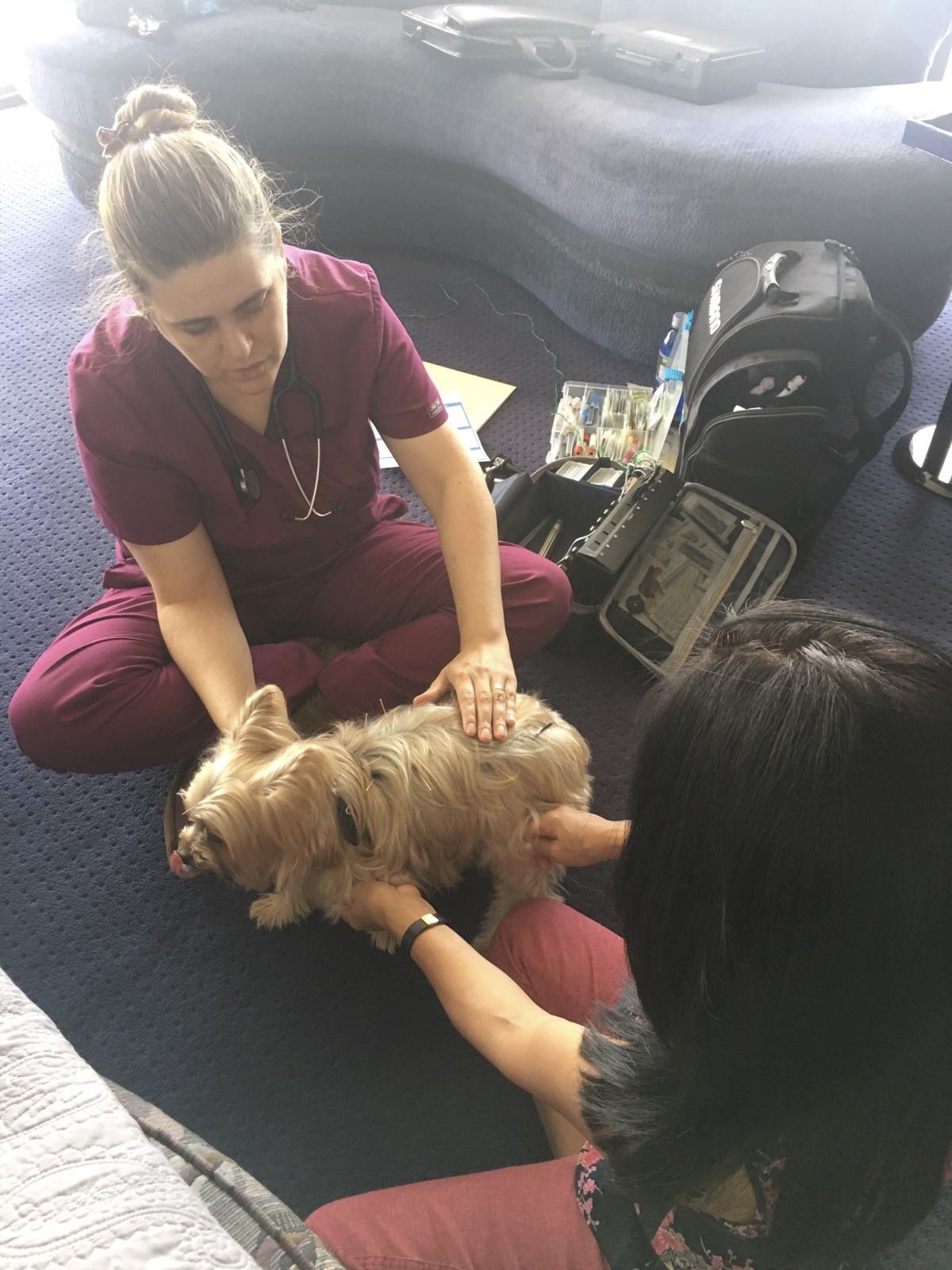
Massage Therapy & E-stim acupuncture for a Yorkie
The International Academy of Veterinary Pain Management is an organization of health care practitioners including, veterinarians, medical doctors, veterinary technicians, and other licensed health care practitioners who have committed to practice, study and research non-human (animals’) pain management from an allopathic, rehabilitation and/or acupuncture and Traditional Chinese Medicine basis.
How Does Excellent Pain Management Help My Pet?
You would think this answer was obvious, wouldn’t you? We do not want any of our family members to be in pain- especially our animal family. We design and manage our pets’ lifestyles, including their food, exercise and entertainment. We could argue we have a special responsibility to be mindful and considerate when planning for our pets’ comfort and enjoyment.
Creative and forward-thinking pain management can help in ways we cannot intuit. For example, can we help our pets digest better and enjoy their food if they are not in pain? Can we help them live longer, need less surgeries, feel less itchy? Absolutely. If our pets are happy and energetic and relaxed, are we healthier and more relaxed? Absolutely. Attention to your pets’ happiness and health makes your whole family- pets and people- healthier.
What is New or Interesting About Pain Management?
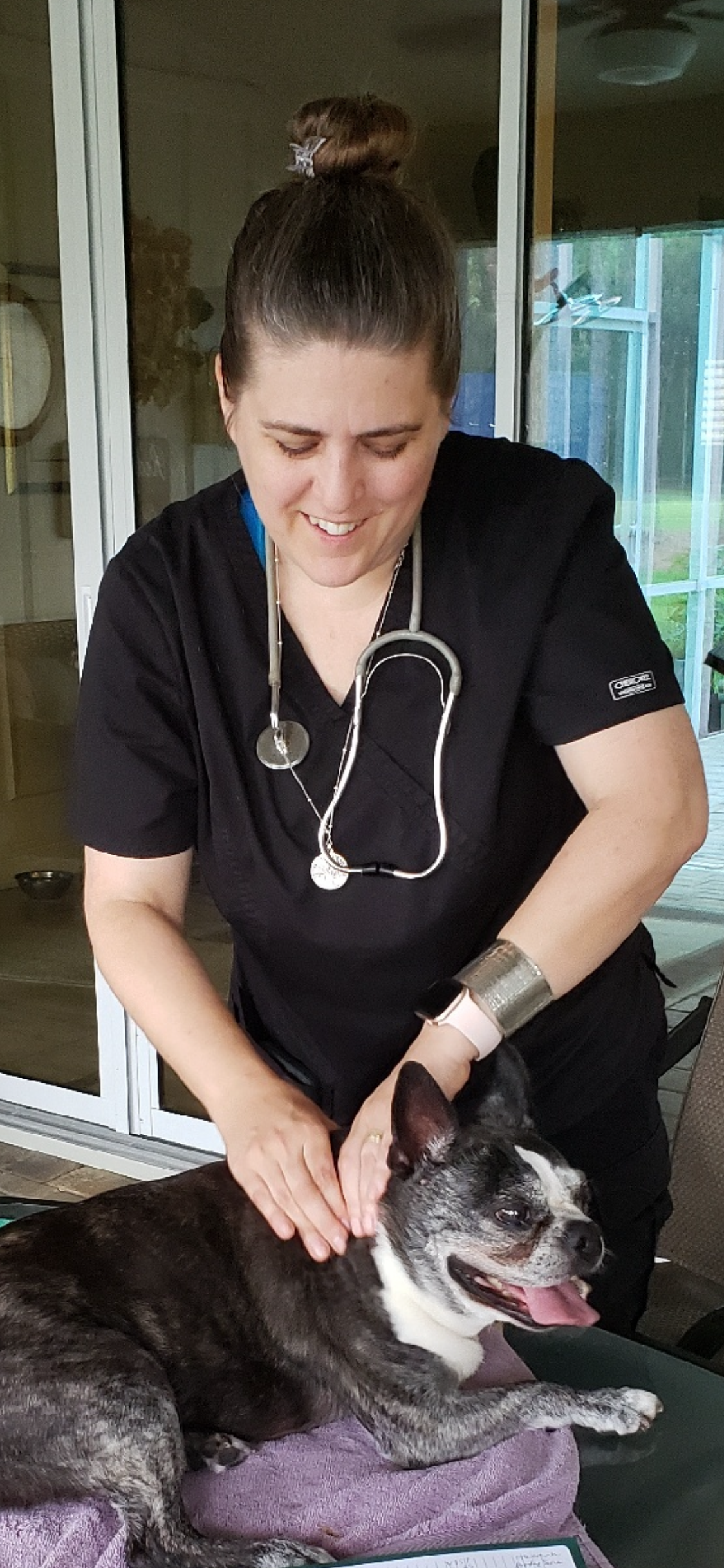
Doc Truli perform Tui-na massage on Senior Boston Terrier
We can prescribe allopathic medications – like non-steroidal anti-inflammatory painkillers. We can prescribe herbal formulas. We can use electromagnetic devices like the Assisi Loop. We can perform hands on therapies like massage, laser treatment, acupuncture, osteopathy, medical manipulation (like chiropractic adjustments in humans.) We can ensure modern anesthetic protocols that minimize pain.
But what is new and interesting is the new specialty of palliative care medicine and the relatively new study of rehabilitation and physical therapy techniques for pets. The application of functional neurology, nutritional response testing and tui-na (pronounced twee-nah) medical massage for the benefit of our animal friends and companions is exciting and meaningful work. Your pet can benefit from these sciences and technologies, whether they are new or ancient.
Does My Pet Have to Be in Pain to Benefit from Pain Management?
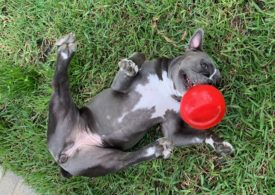
This Olde English Bulldogge is a prime candidate for pain recognition training because she is rambunctious.
No! They do not.
You can learn pain management concepts and techniques to identify when and if your pet is in pain. You can learn how to manage small injuries and oops! to prevent chronic pain or weakening of knees, shoulders, hips and back. You can learn healthy lifestyle choices to keep your pet out of pain like what to feed, what to supplement and how to train for maximum fun and minimum injury. Your trusted neighborhood veterinary team should be available to help teach you and check in with you so you can manage your pets’ lifestyle for optimum pain avoidance.
Text (813) 714-7863 and share your name, number, email, address, pet’s name, and urgency of situation to request to become a client or for more information.
Professional Guidance for Canine Yeast Dermatitis
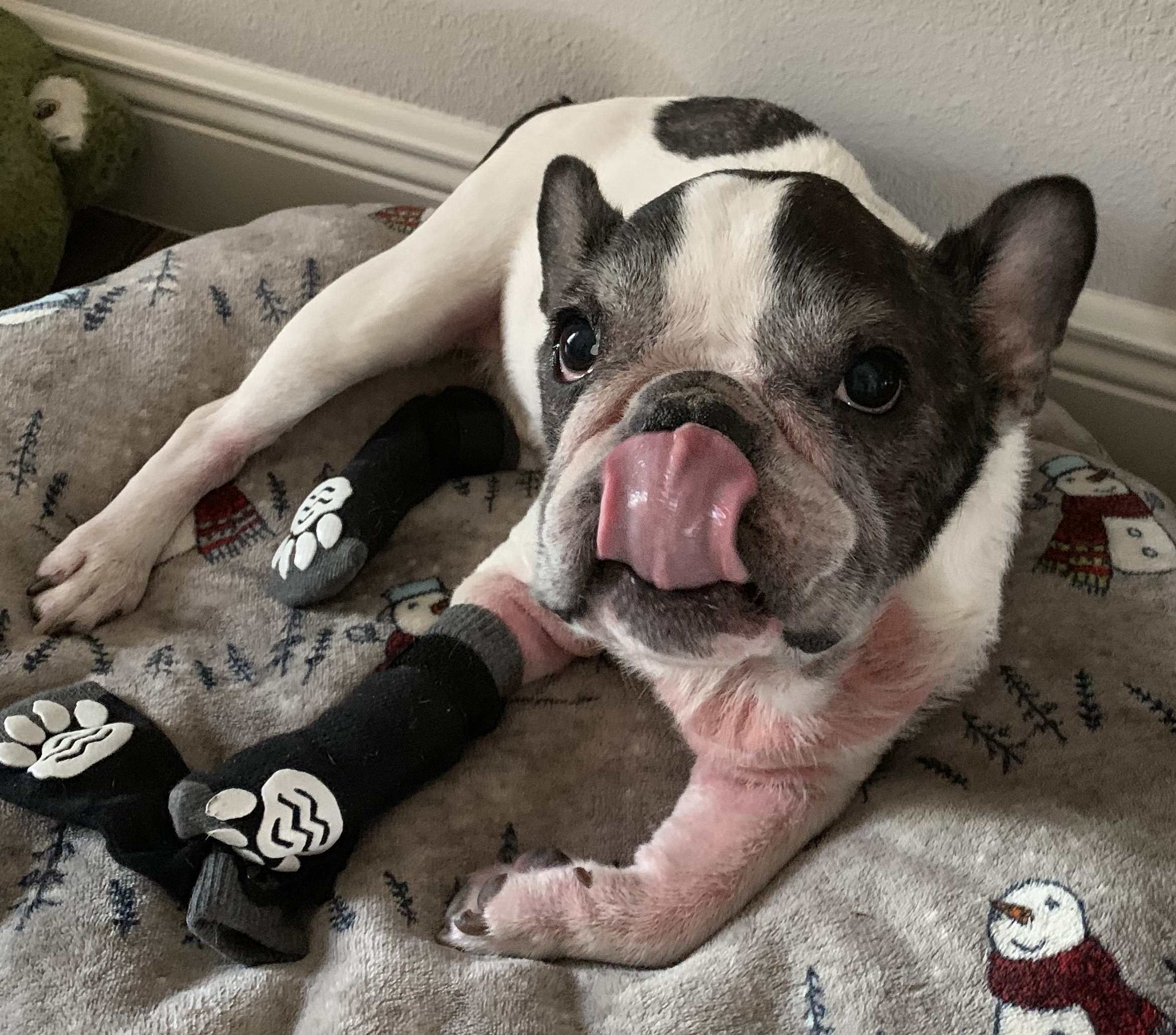
My poor itchy legs!
You know the smell. That yeasty, warm, sickly smell coming from your dog’s head or skin or their bed? The skin is red or bright pink. It is dry with flakes and itches like crazy. You have gone to the veterinarian 4-6 times in the past 2 years and you are frustrated with the money spent and the lack of results. You are researching holistic vets on the internet to find relief for your dog. You desperately need professional veterinary guidance.
Here’s What Goes Wrong with Chronic Dog Skin Infections
Which one are you?
We want our dogs playing and swimming well into their senior years. Here’s where to start.
Catch It Early
Have your veterinarian examine your puppy carefully for signs of pain — puppies shouldn’t hurt. A puppy with a quirky or unique way of sitting, standing, walking, or running may be compensating for hip or elbow dysplasia, the root cause of most canine osteoarthritis. Caught early, several interventions can help a young dog develop with less pain down the road.
Grow Puppies Slowly
Rapid growth is a major driver of later-life osteoarthritis. Dogs expected to weigh over 44 pounds as adults should stay on large-breed puppy food — never switched early to adult food, which is proportionally higher in carbohydrates relative to protein. Watch out for “grain-free” labeling too: novel carbs like potatoes, chickpeas, quinoa, and peas still fuel rapid growth and should stay a minor part of a puppy’s diet.
Move — But Not Too Much or Too Little
Dogs who get 60+ minutes of daily exercise have significantly less osteoarthritis than dogs getting 20 minutes or less. Two relaxed 30-minute walks a day is a great target. If your dog already has arthritis, ask your veterinary team about a referral to a veterinarian certified in Canine Sports Medicine and Rehabilitation — these specialists use tools like cavalettis, underwater treadmills, massage therapy, and at-home stretch routines to keep dogs moving comfortably.
Keep Them Lean
Dogs with portion-controlled meals and healthy body condition have less arthritis than dogs who cycle through weight gain and loss — cartilage damage from the “fat years” doesn’t fully reverse. Ask your veterinarian to help you dial in the right portions for your dog’s life stage.
How Ancient Law Pet Wellness Can Help
Diagnosis, imaging, and prescription pain management should go through your dog’s veterinarian. Once you have a diagnosis, our Canine Rehabilitation program and Tui-na Massage sessions are built to support arthritic and post-orthopedic dogs — targeted mobility exercises, hands-on bodywork, and a home exercise plan you can keep up between visits. For dogs managing chronic pain long-term, our Palliative Care Consulting can help coordinate comfort-focused support alongside your vet’s treatment plan. Reach out at JLaw@VetVmd.com or call/text (813) 816-1759.
What Most Pet Parents Already Know
If you’re already feeding a quality omega-3 supplement, you probably know some of the basics: cheap supplements often use an “ethyl ester” form that’s less bioavailable (a simple, if slightly odd, home test — letting the oil sit in a styrofoam cup for about 15 minutes — will show it eating through the cup if it’s ethyl ester form). You may know that oily fish like mackerel, sardines, and anchovies, or a few weekly cooked egg yolks, can provide omega-3s without a supplement — and that heavy-metal accumulation in large predatory fish like salmon means sourcing matters, whether from krill, New Zealand mussel, or verified low-mercury fish oil. You may also know that while seaweed-derived omega-3s can support a vegetarian dog’s coat, they won’t deliver the same anti-inflammatory benefit as marine-sourced EPA.
What’s Harder to Know Without Testing
Even well-informed pet parents run into a wall here: there’s no way to reliably calculate the “right” dose of omega-3 for an individual dog or cat from formulas alone. Littermates on identical diets can show meaningfully different omega fatty acid profiles in their red blood cell membranes — which is the current gold-standard way to measure this, though it’s a technically demanding test to run well.
Why Testing Can Be Worth It
More isn’t automatically better with omega-3s — they can accumulate to problematic levels, can be difficult for some pets to digest, and quality supplementation isn’t cheap. Testing (a small blood sample sent to a specialized lab) tells you and your veterinarian whether your current dose is actually therapeutic — recent research has shown some pets need meaningfully more than label-dose omega-3 to see real benefit for joints, heart, or kidney support, while others may already be getting enough.
How Ancient Law Pet Wellness Can Help
Ordering and interpreting omega fatty acid bloodwork is something to arrange through your veterinarian. Once you have those results, our TCVM Food Therapy consulting can help translate the numbers into a practical feeding and supplementation plan — sourcing decisions, dosing adjustments, and how to fit omega-3 support into your dog or cat’s broader diet. Reach out at JLaw@VetVmd.com or call/text (813) 816-1759.
If you cook for your dog — or want to start — you’re right to think about how to keep the recipe nutritionally balanced. Here’s a checklist and a few answers to the questions we hear most.
Checklist to Home-Cook for Your Dog
- A veterinarian or veterinary nutritionist who can design (or review) computer-balanced recipes
- A consistent source of quality ingredients
- A meal plan with both make-ahead and quick-cook balanced recipes
- Basic kitchen skills — measuring ingredients, a little cooking
Frequently Asked Questions
Why does the recipe need to be so precisely balanced? Dogs have shorter lifespans than humans, which means less time to recover from nutritional mistakes. It’s worth getting the recipe right from the start.
Do I have to cook every day? No — a good meal plan includes recipes you can batch-cook and freeze in individual portions, plus a few balanced “quick-cook” options for busy days (a balanced tofu-egg scramble is a popular one).
Can I test whether my recipe is nutritionally complete? Not practically — full nutrient analysis of a single meal costs thousands of dollars. It’s usually faster and cheaper to have a veterinary nutritionist formulate the recipe correctly from the start than to test an existing one.
Can I test if my dog is doing okay on the diet? Not directly, but newer, more affordable testing can check things like Vitamin D and Magnesium status, and your veterinarian can adjust the recipe if levels are off.
If the diet is computer-balanced, why would a nutrient like Vitamin D still come back low? Individual dogs metabolize nutrients differently, and some ingredient combinations affect absorption. This is exactly the kind of pattern a veterinarian familiar with nutrition can help you troubleshoot.
Is there a cookbook with reliable recipes already balanced? Some exist, but a recent survey found many published recipes were improperly balanced and a few were potentially unsafe. Ingredients and products also change over time, which can quietly throw off an otherwise-good recipe.
What Bloodwork Should Home-Cooking Dogs Have — and Why
Regular physical exams with your veterinarian are the foundation of monitoring any diet. Ask your vet about a yearly (or more frequent) CBC/Chem panel — not because any single result “approves” your recipe, but because it builds your dog’s own individual baseline. Most published research on blood values is based on commercially-fed dogs; a home-cooked dog may show different patterns, and nobody knows yet how meaningful those differences are. Tracking your own dog’s numbers over time gives you and your vet real, individualized data instead of relying on population averages that may not apply.
Bloodwork worth discussing with your veterinarian:
- Complete blood count (red and white blood cells and associated parameters)
- Serum chemistries (albumin, cholesterol, ALT, AST, AlkPhos, BUN, creatinine, phosphorus, calcium, total protein, globulins)
- Vitamin D3, B12, B6
- Omega fatty acid ratio (AA:EPA+DHA)
Your veterinarian can order these panels and interpret the results in the context of your dog’s individual health picture.
How Ancient Law Pet Wellness Can Help
While bloodwork and lab interpretation should go through your dog’s regular veterinarian, our TCVM Food Therapy consulting is built exactly for home-cooking pet parents — we help you design custom-balanced recipes and meal plans, and factor in Traditional Chinese Medicine food energetics alongside your vet’s lab results. Reach out at JLaw@VetVmd.com or call/text (813) 816-1759.
Real food is basic, minimally processed ingredients cooked for your dog — ideally fresh, non-GMO, and organic where practical. It’s a simple concept with an outsized effect: real food tends to taste better to your dog and can support a calmer, healthier pet. For a lot of pet parents, it’s also just a meaningful way to show care.
Ways to Get There
Cook at home. The most hands-on approach: get a balanced recipe designed by a veterinarian trained in nutrition (or a board-certified veterinary nutritionist), then cook it yourself — crock pot, casserole, or meatloaf-style batches work well and can often be frozen in individual portions for smaller dogs.
Hire a “doggy chef.” Have your veterinarian design or approve the recipe, then hand it to a chef service to prepare. Be cautious of services that design the recipe themselves without a veterinarian examining your pet first — in many states, that crosses into the practice of veterinary medicine, and there are hundreds of medical conditions (bladder stones, IBD, allergies, and more) that change what “balanced” actually means for a given dog.
Buy from a “doggy cafe.” A growing number of dog-focused cafes and eateries offer prepared meals. These are made for dogs in general, not your specific dog, so they’re a fun option for variety but not something to rely on exclusively long-term without veterinary input.
Fresh meal delivery. Similar tradeoff — convenient and made from real ingredients, but not individually balanced for your pet.
TCVM-aligned commercial brands. A few companies (Honest Kitchen, PetTao, Simple Food Project, among others) formulate according to Chinese food-therapy combining principles and source ingredients thoughtfully, even if not 100% organic (which realistically is only achievable with full home-cooking).
How Ancient Law Pet Wellness Can Help
Designing or approving a fully balanced home-cooked recipe is work for your veterinarian or a veterinary nutritionist. Once that foundation is in place — or if you’re using a commercial real-food option — our TCVM Food Therapy consulting helps you layer in food-energetics principles suited to your dog’s individual constitution, and helps you evaluate and optimize whatever feeding approach you’re already using. Reach out at JLaw@VetVmd.com or call/text (813) 816-1759 to get started.
What Actually Makes a Dog “Senior”?
Pet food packaging often labels dogs “senior” starting at 7 or 8 years old — but that’s a marketing convenience, not a biological rule. So much depends on breed, genetics, early-life nutrition, and lifestyle. A giant breed like a Great Dane may be considered senior at 4-6 years old, while a Chihuahua or Yorkie might not hit that stage until 10-12. A Labrador Retriever, prone to low thyroid function as young as age 2, may benefit from earlier screening than the “senior” label would suggest.
The real answer: “senior” status should be decided individually, with your family veterinarian, based on your dog’s specific breed tendencies, health history, and how they’re actually doing — not a number on a bag of dog food.
Why the Senior Conversation Matters
Dogs of every age deserve focused attention to their health and quality of life — not just once they’re labeled “senior.” A useful question to ask your veterinarian: should my dog have expanded screening for their breed’s known risk factors, even before symptoms show up? For breeds prone to specific conditions, catching a trend early — months or years before an official diagnosis — often opens up more options.
Quality of life tracking is worth starting long before your dog seems to be struggling. Ask your veterinarian whether they use a quality-of-life scale as part of routine exams; a small trend downward, caught early, is much easier to address than a crisis.
What Can Be Done for a Senior Dog?
Once senior-type concerns are on the table, your veterinarian has many tools available — prescription diets for joint mobility, cognitive support, or weight management; guidance on appropriate exercise; mobility aids like carts and lift harnesses. Ask specifically about palliative and hospice care training — a growing certification field that applies solid science from human hospice medicine to help pets live longer, more comfortable lives, well before end-of-life decisions are on the table.
Food Matters More Than Almost Anything Else
Every dog — senior or not — benefits from a real look at their food foundation. Nutrition consults are personalized, time-intensive work, and a good one is worth the investment. A useful way to think about your options, roughly in order of increasing customization:
- Base level: a life-stage-appropriate, AAFCO-formulated commercial food
- Level up: the same base food with a small amount (under 10%) of fresh, cooked real-food toppers, ideally with your veterinarian’s input
- More involved: a fully home-cooked, balanced diet designed by a veterinarian trained in nutrition, or a board-certified veterinary nutritionist
- Most individualized: a home-cooked diet further customized around your dog’s specific TCVM food-energetics pattern, guided by a trained practitioner
Raw diets, raw meaty bones, and grain-free formulations can all fit into a healthy plan or work against one — it depends heavily on execution and your dog’s individual needs, so loop in your veterinarian before making a major diet change.
A Note on What “Working” Looks Like
A good rule of thumb for any new plan — diet, supplement, or therapy — is that you should be able to see and feel a difference within days to a few weeks. If you’re not seeing results, that’s useful information: it’s time to adjust the plan, not just wait longer.
How Ancient Law Pet Wellness Can Help
Diagnosis, bloodwork, and prescription treatment plans should go through your dog’s veterinarian. Where our team comes in: our TCVM Food Therapy consulting helps you build and refine a feeding plan suited to your senior dog’s constitution and health picture, in partnership with your vet’s recommendations. Our Canine Rehabilitation and Tui-na Massage sessions support mobility and comfort for aging joints, and our Palliative Care Consulting helps coordinate quality-of-life support for dogs managing chronic conditions long-term. Reach out at JLaw@VetVmd.com or call/text (813) 816-1759.