Including: Ileopsoas Muscle Tear, How to Care for Your Dogs’ Fentanyl Patch, & All-Natural Class IV Laser Therapy
The Collision
“Doc, I was just stopped to aid another car that was pulled over on the side of the highway. Thank goodness I wasn’t in the car, but Maxx was in his kennel in the back,” said Maxx’s dad.
“Next thing I knew, I heard car tires screeching from about 200 yards away. Judging by the skid marks in daylight the next morning, he must’ve been going at least 100 mph. He hit the back left tire. The axle of his car stuck in my back tire and he just crushed the side of my car. Would you believe the guy tried to run?”
A healthy six-year-old German Shepherd, Maxx was in the back passenger compartment of the car at the time. He bounced around inside his vehicle as the forces of the oncoming car reverberated through the stopped car and through his German Shepherd body.
Just by looking at Maxx, you would not guess he had been through an excessive automobile trauma. Until you saw him try to get up and walk. read more…
Boxer Needs Prepuce Exam
Veterinary medicine presents constant new challenges. Franklin was one of those challenges. A handsome, happy 11-year-old Boxer undergoing successful chemotherapy, he had a problem that kept flaring up about 2 days after each chemotherapy treatment. Franklin would start leaking and dripping gooey green pus from his prepuce. The prepuce is the skin pouch the penis lives in. So basically, he was dripping pus from his penis. But not exactly, because the penis was okay and his bladder was bacteria-free.
Franklin was a typical hyperactive Boxer which made holding him still for a detailed examination impossible. Doc Truli sedated the old boxer gentleman and proceeded to attempt a prepuce examination.
Normally, the prepuce can be reflected back and the penis extruded for a thorough exam. We needed to be sure Franklin did not have a metastatic tumor in there, or foreign material like a plant sticker or awn. But, because of the recurring nature of the problem, the prepuce was stuck, and would not reflect back far enough for a complete examination.
That’s when yours Truli got an idea. read more…
Sick Cats Need TLC
Cats are trickier to care for than most dogs.
In the US, there are about 5% more cat than dog households. About 65% to 60%. (That means, for all you pet lovers out there, 40% of households do not have a pet. Yes! 40%, Can you believe that?!) Yet cat medicine is still a new endeavor. Cats are not small dogs. We learned that in the 1970’s, when cats went blind and suffered dilated cardiomyopathy from lack of the essential amino acid taurine. Dogs and humans assemble their own taurine in the body. Cats do not. So the poor things were going blind and suffering heart attacks because no one knew!
Cats are tricky to hold, restrain, and work with. And they oftentimes hide their symptoms of illness until they are rip-roaring super-duper sick. A sick cat often needs intravenous fluids to save his or her life.
Many people ask Doc Truli, “How do you keep an i.v. in a cat?”
Well now, that’s a good question. read more…
What?
Okay, okay. Sometimes doctors get carried away. But, if you saw this lump, you’d be speechless, too.
Ready for it? read more…
Fat Dachshund Reminds VirtuaVet of a Purina MisLeada’
The Scoop on Fat Dogs and Purina Dog Food
Picture fit, thin, healthy, happy yellow Labrador Retrievers galloping along a sandy shoreline, their paws splash in the surf , their long red tongues lolling out the side of their mouths. Happiness and health exude from their every golden fur on their hairy, shaggy, tail-wagging fit bodies.
That’s a beautiful Purina dog food commercial that implies feeding Purina Dog Food will keep your dog fit and trim and healthy. The narrator states that a study shows that dogs that eat Purina stay fit. You know the ad if you watch American television.
Doc Truli always laughs when that ad comes on with the suggestive voice over. You really think Purina food alone made those dogs so healthy and happy. read more…
from → Did You Know?, Wild Animals
Ringworm Fungus Infects Mangrove Kitten
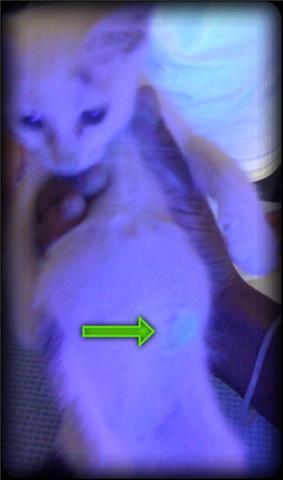
Quick, Basic Ringworm Diagnosis
A tiny, short-haired white green-eyed kitten with a grey smudge on the top of her head toddled across the examination table and butted her head into my outstretched palm. What a sweetie!
“I found her starving in the mangroves by the State Park,” said her new daddy. “We call her Sissy.”
Sissy had fleas, earmites, a huge belly full of worms, and a round reddish-sore almost bald spot on the underside of her belly. A quick turn out of the lights and turn on of an ultraviolet “UV” Wood’s lamp, and a few seconds later, there was our answer. Sissy glowed from a fungal infection. 50% of ringworm infections glow; 50% do not! read more…
2-Year-Old Cat Breathing With Difficulty
“Doc, I don’t understand it. Pluto was fine yesterday. This morning, he looked a little tired, didn’t want to eat much of his breakfast and he can’t meow,” said the concerned dad of a big black and white short-haired Tuxedo Cat. “In fact,” he went on,”we never heard him purr until this morning. Usually we could feel the purr, but never hear it.”
10-Week Old Kitten with Lump on Neck
“I just noticed a lump on June’s neck on the left side below her chin. Last night, it was bigger and she was sleepy and didn’t want to eat dinner. Today the bump is smaller and she looks brighter, but she can’t meow anymore,” said June the Kitten’s worried mom. “What is going on?”
A Problem That Appears Fast and Spreads Faster
A “hot spot” — the technical term is pyotraumatic dermatitis — is a patch of raw, infected, intensely itchy skin that can appear within hours and looks far worse (and covers far more area) than most pet parents expect once the fur around it is clipped away.
Common Signs
- Sudden, obsessive itching or licking at one spot
- Common locations: cheeks, under the ears, haunches, sides, base of the tail — though it can occur almost anywhere
- A wet, matted clump of fur, or a crusty patch if it’s been developing for a day or two
- The visible damage is almost always more extensive than it first appears — what looks like a small spot often turns out to extend much further once the fur is clipped back
What Triggers a Hot Spot?
An initial irritation — an allergy flare, an insect bite, a scrape, prolonged dampness (a wet coat left un-dried after swimming or bathing is a classic trigger) — disrupts the skin’s normal bacterial balance. The bacteria already living on the skin can turn aggressive very quickly, and the itch-scratch cycle makes it worse fast.
What Treatment Typically Involves
Hot spots usually need prompt veterinary attention. Your veterinarian will typically clip the fur away from the entire affected area (which is often larger than it appears), clean and disinfect the exposed skin, and may recommend an anti-inflammatory medication to calm the itch and a course of antibiotics to address the infection. In more severe or long-standing cases, sedation may be needed to complete the cleaning comfortably. This is not a “wait it out” condition — a hot spot can spread significantly under the fur within just a day or two if left untreated.
Prevention
- Dry your dog thoroughly after swimming or bathing — this matters even more for thick-coated breeds (Huskies, German Shepherds, Newfoundlands, Rottweilers, and similar breeds), since trapped moisture under a heavy coat is a classic setup for a hot spot
- Keep up with a gentle, appropriate bathing routine, and always rinse thoroughly — leftover shampoo residue can itself be irritating
- Stay current on flea prevention, since flea bites are a common underlying trigger
- If your dog has recurring hot spots, it’s worth exploring whether an underlying allergy is the real root cause, rather than treating each episode as an isolated event
How Ancient Law Pet Wellness Can Help
Diagnosis and treatment of an active hot spot should go through your veterinarian promptly — this isn’t a condition to manage at home alone. Where our team can help is on the “why does this keep happening” side: if your dog has recurring skin flare-ups, our TCVM Food Therapy consulting can help investigate whether diet and food-energetics are part of the underlying allergy pattern, in partnership with your vet. Reach out at JLaw@VetVmd.com or call/text (813) 816-1759.